


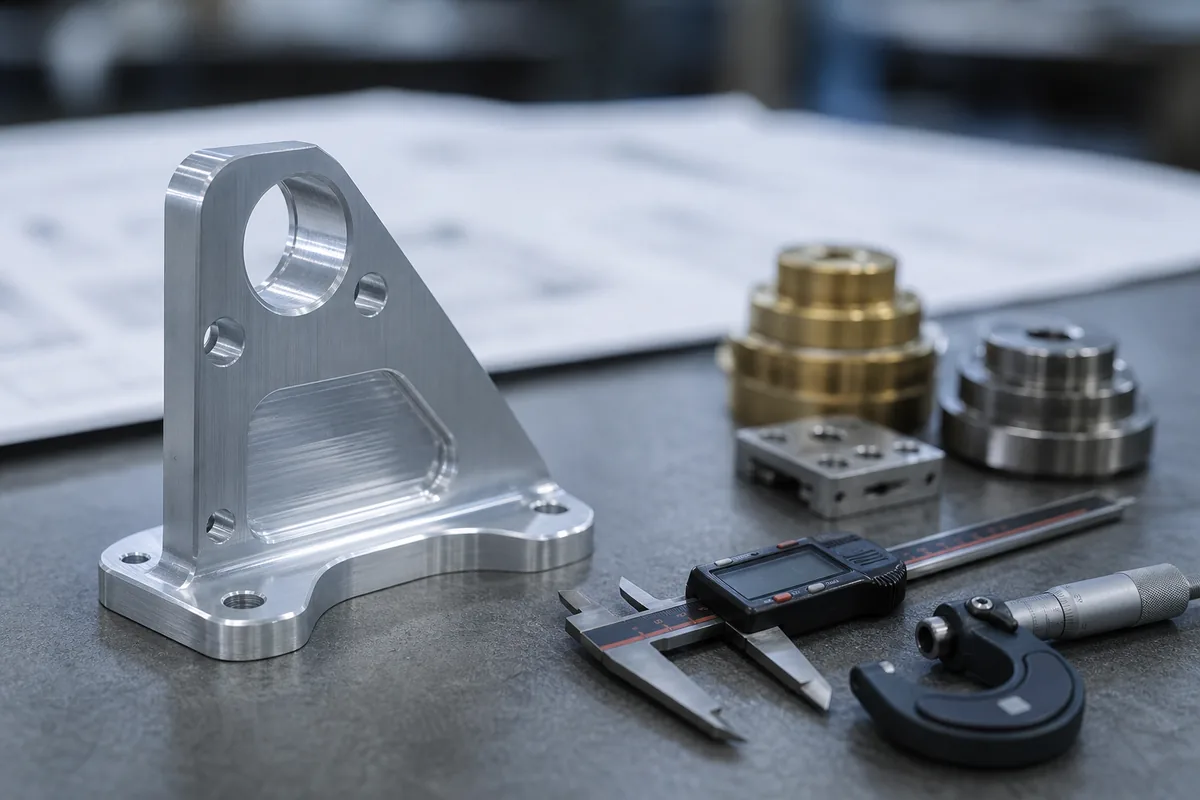
A machined bracket arrives with three quotes: $18.40, $26.90 and $41.10. All three suppliers received the same STEP file. Two of them will deliver a part that fits. One will not, and the quote does not tell you which.
Quotes are not prices. They are a supplier's model of how much work your drawing implies, and the model differs from shop to shop because each shop fills gaps in your specification differently. Learning to read a quote line by line is the fastest way to see where the money actually goes — and where a supplier is guessing.
A professional quote has at least five separable lines. If you receive a single number, you cannot compare it to anything, and you cannot tell a real efficiency advantage from a missing step.
| Line item | What it covers | Typical share |
|---|---|---|
| Material | Bar or plate, buy-to-size, scrap allowance | 15–35% |
| Programming and setup | CAM time, fixturing, first-article proving | 10–25% |
| Machining (cycle time) | Roughing, finishing, tool changes, per piece | 30–50% |
| Finishing | Anodizing, passivation, powder coat, masking | 5–20% |
| Inspection and documentation | FAIR, sampling, CMM time, material certs | 5–15% |
| Packaging and freight | Protective packing, consolidation, Incoterms | 2–8% |
The percentages shift with quantity and geometry, and that is exactly what makes them diagnostic. A quote where setup is 40% of the total at 500 pieces means the supplier priced a prototype flow for a production order.
Material looks like the simplest line and is the most frequently underestimated. Three things move it:
Ask for the material specification on the quote. If it says "AL 6061" without temper, the tolerance on your flatness callout may not survive.
Setup is the only line that genuinely falls with quantity, because programming and fixturing happen once. This is why the same part quoted at 1, 50 and 500 pieces should show sharply different unit prices — and why a flat per-unit price across all three quantities is a warning sign.
Setup rises with:
A $400 setup on a $12 part is normal. A $400 setup on a part quoted at $11.60 tells you the shop is treating it as a one-off and has not planned for repeat production.
Cycle time is the line that separates suppliers who understand machining from suppliers who understand quoting software. Two shops can quote the same part with a 30% difference in cycle time because one has planned tool paths that avoid unnecessary retracts, uses the right cutter for each feature, and machines features in an order that minimises repositioning.
You cannot audit a cycle time from a quote, but you can sanity-check it: a part with 40 tapped holes and a deep pocket should not have a cycle time identical to a simple plate of the same envelope.
Anodizing, passivation, powder coating and heat treatment are usually subcontracted. A quote that does not list finishing separately is either excluding it — in which case your landed cost is higher than the number in front of you — or absorbing it invisibly, which means the finish is not being inspected.
Ask three questions on any cosmetic part: which finishing process, which class or thickness, and who performs it. Type II anodize at 10 µm and Type III at 50 µm differ by roughly 3× in cost and behave differently on threaded features, where build-up can close a thread unless it is masked.
Inspection is the line buyers cut first and regret later. Three levels are common:
The cost difference between the first and second is usually 5–10% of the part price. The cost of skipping it is a rejected batch after assembly, when the fix is no longer a phone call.
Line up the quotes side by side and normalise before comparing:
Once normalised, the spread usually collapses from 2× to 15–20%. The remaining difference is a genuine efficiency signal — shop utilisation, machine capability, or wage structure — and that is the number worth negotiating.
Because programming, fixturing and first-article inspection happen once regardless of quantity. On a moderately complex part, the first unit often carries 60–70% of the total setup cost.
Yes, in one request. The shape of the curve tells you how much of the price is setup versus recurring cost, and it reveals whether the supplier has a production flow at all.
No. A shop with the right machine and high utilisation can legitimately be 20% cheaper. The risk is not the low number — it is a low number you cannot explain from the line items.
Usually soft jaws, fixtures and custom workholding rather than a mould. It is often charged once and should be quoted separately so you know what you are paying for and who owns it.
Ask for the inspection plan with the quote: which dimensions are measured, on what equipment, and whether a report ships with the parts. If the answer is vague, the report will be too.
Two quotes differ by 80% and the line items look superficially similar. This is the moment most buyers either accept the cheaper number or assume the dearer supplier is gouging. Both reactions skip the useful question: which assumption differs?
In practice, a large gap almost always traces to one of five causes, and each has a different remedy.
The way to resolve it is not to negotiate but to ask both suppliers the same three questions: which machine, how many setups, and what is included in finishing and inspection. The answers usually explain the gap in one round of email, and occasionally reveal that one quote is simply wrong — for example, priced from a 2D drawing that omitted a face.
There is one more case worth naming: a quote that is low because the shop has capacity and is buying work. That is a legitimate discount and it will not last. It is worth taking if the supplier's inspection process is real, and worth verifying with a small first order before committing a production run.
Demand a breakdown. Compare on normalised specifications. Read setup as a signal of whether the supplier planned for your quantity, and read finishing and inspection as signals of whether they planned for your part at all. The cheapest complete quote is almost always the right answer — the cheapest incomplete one is not.
If you want a quote with the line items visible, send us a drawing and a target quantity — we return the breakdown, the DFM notes, and an honest statement of which tolerances are costing you money for no functional benefit.

