


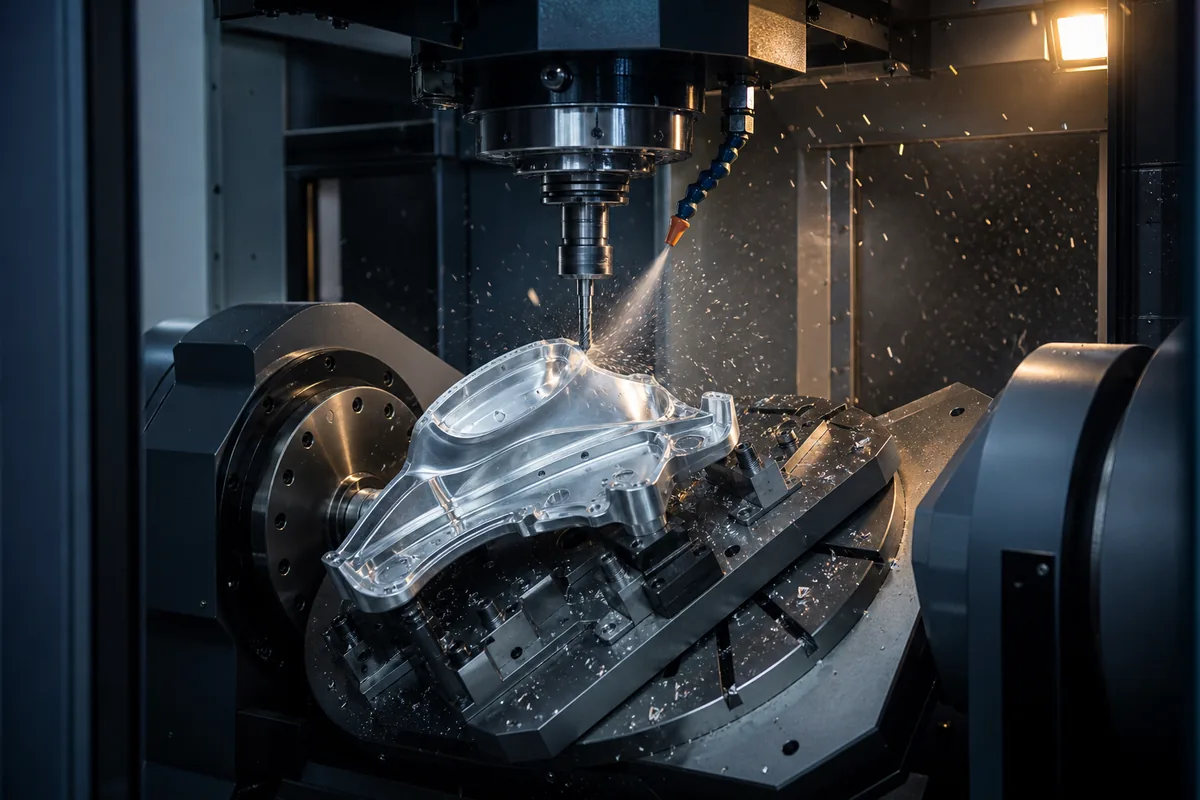
Five-axis machining is sold as a capability upgrade, and in some shops it is treated as a badge. In practice it solves a specific set of problems and is irrelevant to a larger set — and paying a 5-axis hourly rate for a part that a 3-axis mill makes in one setup is one of the most common ways to overspend on machined components.
Here is the decision framework we use when a new RFQ arrives: not "can we do this on five axes" but "does the fifth axis remove a real cost".
A 3-axis machine moves the tool in X, Y and Z. The part stays in one orientation, so every face that cannot be reached from the top must be re-fixtured — usually three to five setups for a prismatic part with features on multiple faces.
A 4-axis machine adds rotation about one axis, typically A (tilting the table or head). This is what makes cylindrical work efficient: shafts, bushings and parts with features distributed around a bore.
A 5-axis machine adds a second rotary axis, so the tool can approach the part from almost any direction. Two configurations dominate:
The practical consequence: on a 5-axis machine, a part with features on five faces can often be finished in one setup, with one datum, and with the positional error between faces determined by the machine rather than by how carefully an operator re-indicated the part.
If a hole on the front face must align with a bore on the side face within 0.02 mm, re-fixturing is the dominant error source. A 3-axis shop will hit it — with a fixture, an indicator, and operator time — but the yield depends on discipline. On 5-axis the relationship is set by the machine geometry, and the setup disappears.
Impellers, turbine blades, medical implants, and any surface defined by a spline rather than a plane. A ball-nose cutter on a 3-axis machine can approximate these, but the tool tip speed varies across the surface, leaving inconsistent finish. Five-axis keeps the tool normal to the surface, which improves both finish and tool life.
When a pocket has geometry that a straight tool cannot reach without collision, 5-axis lets a shorter, stiffer tool reach it at an angle. This matters more than it sounds: a long, slender tool deflects, which forces lighter passes, which multiplies cycle time.
At low quantity, a dedicated fixture can cost more than the parts. If 5-axis eliminates the fixture entirely, the economics flip even though the hourly rate is higher.
A useful test: sketch the number of setups on 3-axis. If it is one or two, the fifth axis adds cost without removing work.
| 3-axis | 4-axis | 5-axis | |
|---|---|---|---|
| Typical hourly rate (China) | Baseline | +15–30% | +60–120% |
| Setups for a 4-face part | 3–4 | 2 | 1 |
| Positional error across faces | Fixture-dependent | Reduced | Machine-determined |
| Programming effort | Baseline | +20% | +50–100% |
| Best fit | Plates, brackets, simple pockets | Shafts, bushings, radial features | Contoured, multi-face, tight positional |
These are ranges, not rules. The number that matters is total cost at your quantity, and the crossover is often narrower than expected: at 5 pieces of a complex part, one 5-axis setup can beat three 3-axis setups even at double the rate.
Not inherently. It removes fixturing error, which is often the dominant term on multi-face parts. On a single-face part with a tight tolerance, a well-maintained 3-axis machine with a rigid setup can hold the same tolerance at lower cost.
Yes, when setups are the bottleneck. Eliminating three fixtures can cut several days from a prototype schedule. On a simple part it adds a day of programming for no gain.
You can, and it is worth it. If you know the part will run on 5-axis, you can specify features that would be impractical on 3-axis — angled ports, curved channels, blended fillets — without paying a penalty. Design for the process you will actually use.
It is the most under-used option. A 4-axis mill or a lathe with live tooling handles a large share of parts that get quoted on 5-axis by default, at a materially lower rate.
Take a machined aluminum housing, 180 × 120 × 60 mm, with a large pocket on the top face, two Ø12 mm bores on the front face, a row of M5 tapped holes on each side face, and a sealing groove on the bottom. Positional relationship matters between the front bores and the top pocket — 0.03 mm.
| Operation | 3-axis plan | 5-axis plan |
|---|---|---|
| Setup 1 | Top face: pocket, top holes | All faces in one setup |
| Setup 2 | Front face: bores, re-indicate to 0.01 mm | — |
| Setup 3 | Left face: tapped holes | — |
| Setup 4 | Right face: tapped holes | — |
| Setup 5 | Bottom: sealing groove | — |
| Fixturing | Soft jaws plus an angle plate; re-indication each setup | One fixture, no re-indication |
| Positional risk | Accumulates across four re-fixturings | Set by machine kinematics |
At five pieces, the 3-axis plan spends most of its time on setup and indication, and the 0.03 mm positional callout depends on operator discipline four times over. The 5-axis plan has one setup and one inspection. Even at roughly double the hourly rate, the 5-axis quote is frequently the lower total — and it is reliably the lower risk.
Now change one variable: make the part a flat plate with a single pocket and four corner holes. The 3-axis plan is one setup. The 5-axis plan is also one setup, at double the rate, with more programming. On that part the fifth axis is pure cost.
If the part genuinely needs five axes, the RFQ should say so — otherwise the supplier may quote a 3-axis plan with four setups and a fixture, which is cheaper on paper and riskier in practice.
There is a design consequence too. If the part will run on 5-axis, features that would be awkward or impossible on 3-axis become available: angled ports that meet a internal channel cleanly, blended fillets that follow a compound curve, undercut reliefs that would otherwise need a second operation. Designing for the process you will actually use is free; designing for the most constrained process and then paying for capability you do not exploit is not.
One caution: 5-axis does not remove the need for a datum scheme. It removes fixturing error between faces, but the part still needs datums that the CMM can access and that correspond to how the part functions. A part machined perfectly in one setup and inspected against an inaccessible datum is still unverifiable.
Count setups. If 5-axis turns three setups into one, it usually wins. If it turns one into one, it is a rate increase with no benefit. Ask which specific machine will run the part, how many setups it needs, and how position between faces will be verified — the answers tell you whether the capability is real for your geometry.
We run 3, 4 and 5-axis equipment and quote against your geometry rather than against what is idle. See our CNC machining capabilities or send a model and we will tell you which machine should run it — including when the answer is the cheaper one.

