


Sheet metal looks like the simplest manufacturing process on a drawing: cut the flat, bend it, weld if needed. In production it is a sequence of tolerances that accumulate, and the difference between a part that assembles and one that fights you is usually decided by four numbers that never appear on most drawings — bend radius, bend allowance, bend relief, and hole-to-bend distance.
This is a practical guide to the tolerances and DFM rules that decide whether a formed part is one laser program and three bends, or a welded assembly with a fixture and a straightening operation.
| Feature | Typical tolerance | What drives it |
|---|---|---|
| Laser cut outline | ±0.1 mm | Machine accuracy, kerf width, material thickness |
| Hole position (cut) | ±0.1 mm | Same as outline |
| Bend angle | ±1° | Springback, material temper, tooling |
| Bend position (flange length) | ±0.2 mm | Bend allowance calculation, backgauge setting |
| Accumulated across 3 bends | ±0.4 mm | Stack-up of individual bend tolerances |
| Weldment, post-weld | ±0.5–1.0 mm | Heat distortion, fixture rigidity |
The last two rows are the ones that cause trouble. A designer who specifies ±0.1 mm on a final formed dimension across four bends is specifying something the process cannot deliver, and the supplier will either decline or quietly quote a straightening operation.
Every bend needs an inner radius. As a working rule, the minimum inner radius equals the material thickness for mild steel and aluminum, and one to two times thickness for harder tempers and stainless. Below that, the outer surface stretches beyond the material's ductility and you get cracking — visible on aluminum, and often invisible until fatigue on steel.
Specify the radius explicitly. If you leave it to the shop, the flat pattern they calculate may not match the model you designed, and the assembly will not close.
When sheet is bent, the material inside the bend compresses and the outside stretches. Somewhere between them is a neutral axis that neither stretches nor compresses, and the flat pattern length is calculated from it. The position of that axis — the K-factor — depends on the material and the radius-to-thickness ratio, typically falling between 0.33 and 0.5 of the thickness.
This is why a flat pattern exported from CAD without a bend table produces parts that are consistently a few tenths of a millimetre short. The CAD tool uses a default K-factor; the press brake produces a different one. Either supply a bend table matched to the shop's tooling, or accept that the shop will recalculate the flat pattern — and make sure someone checks the result before the laser cuts 200 blanks.
Where two bends meet, or where a bend terminates inside the material, the sheet has nowhere to go. Without a relief notch, the corner tears or buckles. A relief of at least the material thickness, cut slightly past the bend line, prevents both.
Relief is free at design time and expensive afterwards, because fixing it means a new laser program and a new batch.
A hole placed too close to a bend line distorts during forming. The working rule is a minimum distance of 2.5 times material thickness plus the bend radius, measured from the hole edge to the bend line. Closer than that, the hole becomes an oval, and any fastener or pin that was meant to locate in it now locates loosely.
If the design needs a hole closer than the rule allows, the options are: move the hole, add a relief slot, or drill after forming — the last adding a separate operation and cost.
A design that can be folded from one blank with tabs locating into slots avoids welding entirely. Compared with a four-plate welded assembly, the folded version typically costs 30–50% less, and it is dimensionally more consistent because there is no heat input to distort it.
The trade-off is that folded joints are not structural in the same way as a full weld, and they may need a spot weld or rivet for load paths. For enclosures, brackets and covers, folding almost always wins.
Each bend is a separate press-brake hit with its own setup and its own tolerance contribution. Three bends is normal for a bracket; eight bends means the part probably should be a different design. Reviewing a drawing for "can two of these bends become one feature" is one of the highest-return five minutes in DFM.
Available thicknesses are discrete: 1.0, 1.2, 1.5, 2.0, 2.5, 3.0 mm. A design calling for 1.8 mm will be made from 2.0 mm or 1.5 mm, and the resulting part will differ from the model in stiffness and in fit. Pick from the standard list.
Welding introduces three costs that are easy to underestimate:
Specify weld symbols properly. "Weld all around" on a thin panel will produce distortion that no amount of fixture design fully prevents; a stitch weld at the right pitch often performs identically and distorts far less.
Powder coating adds 60–100 µm per surface. That is enough to close a Ø3 mm hole to Ø2.85 mm and to bridge a 0.5 mm gap. If a hole is a locating feature, specify it as masked, and expect masking labour to be a visible line item — on small brackets it is often the largest single finishing cost.
Galvanizing and zinc plating add less but are not dimension-free either. For any part with a tight fit after coating, decide at the drawing stage whether the dimension is pre- or post-finish.
±0.1 mm on cut features is routine. Formed dimensions are ±0.2 mm at best and typically ±0.3 mm across multiple bends. If you need better than that on a formed feature, the feature probably needs to be machined after forming.
Almost always a bend allowance mismatch. The CAD tool's K-factor differs from the shop's tooling and material. Supply a bend table or have the shop verify the flat pattern before cutting.
Not without distortion. Keep hole edges at least 2.5× thickness plus the bend radius away from the bend line, or expect an oval hole.
For prototypes and low volume, yes — no tooling. For high volume of a simple part, punching is faster per piece and the tooling amortises. The crossover is typically in the thousands, and depends on part complexity.
First ask whether it needs to be welded at all — redesigning as a folded part with tab-and-slot joints often removes the fixture, the distortion and a machining operation at once.
The cutting process is chosen before the forming, and it sets the baseline accuracy of every hole and edge in the part.
| Process | Typical cut tolerance | Tooling | Best for |
|---|---|---|---|
| Fibre laser | ±0.1 mm | None | Most sheet parts, prototypes through production |
| CNC punching | ±0.1 mm | Per-shape tooling | High volume, many identical holes |
| Waterjet | ±0.2 mm | None | Thick plate, heat-sensitive material, no heat-affected zone |
| Plasma | ±0.5 mm | None | Thick mild steel where tolerance is loose |
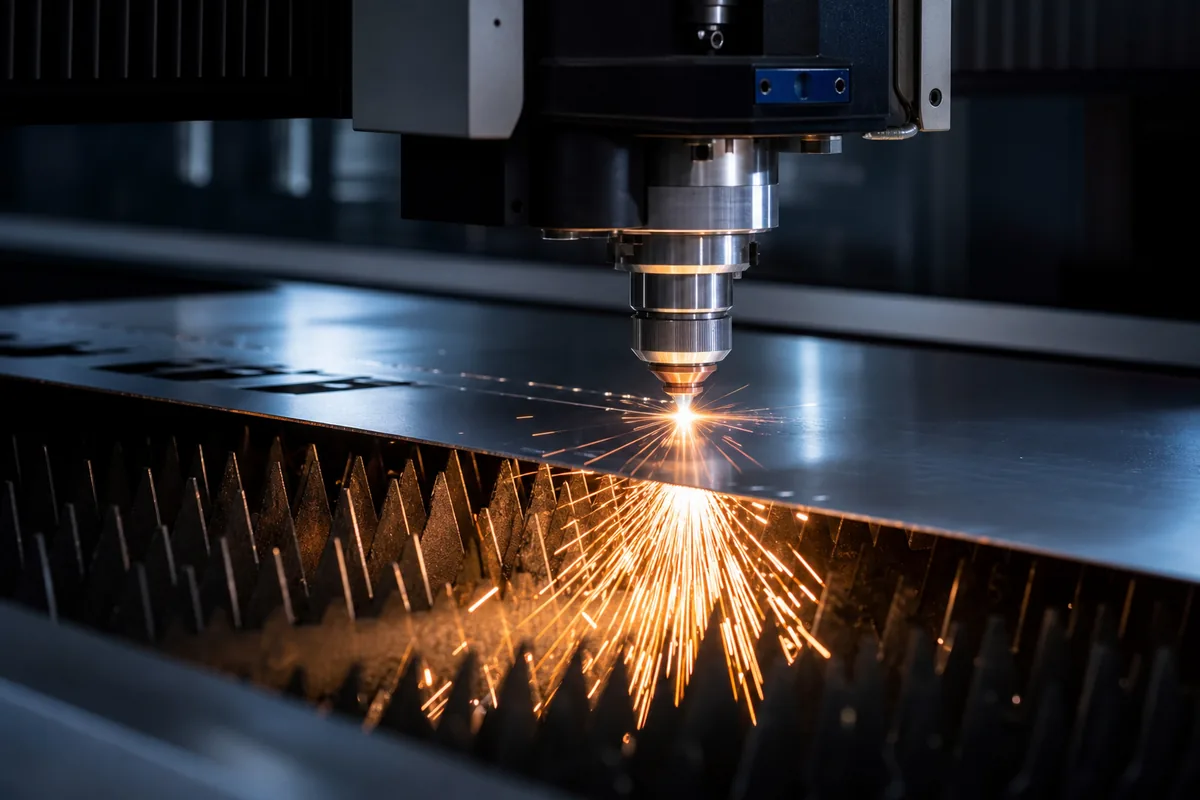
Laser dominates because it needs no tooling and holds a good tolerance across thicknesses up to roughly 12 mm in steel. Its limitation is the heat-affected zone at the cut edge — usually irrelevant, but significant on hardened material or where the edge will be welded and needs a clean metallurgy.
Waterjet has no heat-affected zone and cuts anything, at the cost of speed and a slightly looser tolerance. It is the right answer for thick aluminum plate, for material that would distort under laser, and for parts where the edge will be subsequently machined and must not be hardened.
Punching is faster per part and cheaper per piece at volume, but each hole shape needs a tool. On a part with twelve different hole sizes, the tooling cost and setup time can exceed the laser's advantage until quantities reach the thousands.
The cut program nests parts on the sheet, and the nest determines how much material is scrapped. A part whose outline wastes a large area of the sheet is quoted higher even at the same cut length, because the material is consumed either way. If a design can be nested tightly — rectangular envelopes, common angles, parts that tessellate — the material line drops measurably. This is one reason a small design change on a sheet part can move the price more than a rate negotiation.
Pick standard thicknesses, specify bend radius explicitly, keep holes away from bend lines, and add relief where bends meet. Then ask whether the part can be folded instead of welded — that single question usually moves the price more than any negotiation.
We run laser cutting, press braking and welding in one shop, and we review flat patterns before cutting rather than after. See our sheet metal fabrication capabilities, or send a model and a target quantity and we will come back with the DFM notes that matter before tooling is committed.

