


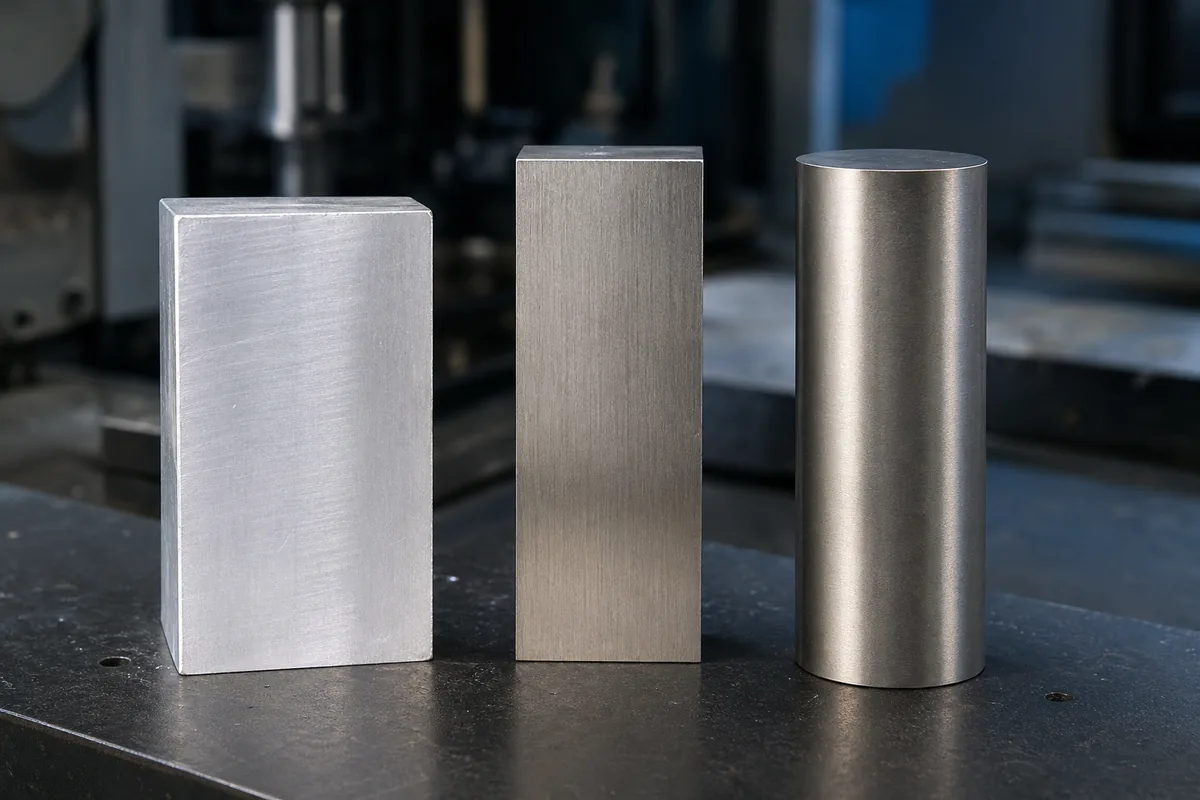
The material choice is usually made in the first ten minutes of a design review, and then held for the life of the product. It is rarely revisited, even when the volume changes, the cost target tightens, or a supplier points out that a different grade would machine in half the time.
Aluminum, steel and titanium each win a specific domain. Choosing between them is less about strength numbers on a datasheet and more about four practical questions: what does the part have to survive, what does it weigh, how many will you make, and can it be machined predictably.
| Aluminum (6061 / 7075) | Steel (mild / alloy / stainless) | Titanium (Grade 5 / Ti-6Al-4V) | |
|---|---|---|---|
| Density | 2.70 g/cm³ | 7.85 g/cm³ | 4.43 g/cm³ |
| Tensile strength | 310 / 570 MPa | 400–1,200 MPa | 950 MPa |
| Machinability | Excellent | Good to moderate | Poor |
| Relative part cost | Baseline | 1.1–1.6× | 3–6× |
| Corrosion resistance | Good (anodize to improve) | Poor unless stainless | Excellent |
| Max service temperature | ~150 °C | 400–600 °C | ~350–400 °C |
Read the machinability row carefully. Titanium's cost is not driven by the price of titanium — it is driven by how slowly it must be cut, how quickly it destroys tooling, and how much of the stock becomes chips.
If a part is not exposed to high temperature, high load or aggressive chemistry, aluminum is usually the correct answer — and the reason is not just that it is cheap per kilogram.
Aluminum machines fast. Cutting speeds are high, tool life is long, and the material is forgiving: it does not work-harden aggressively, it does not require flood cooling to survive, and it holds a fine finish with ordinary tooling. This shows up directly in the quote as a shorter cycle time.
6061 is the general-purpose alloy: weldable, anodizes well, readily available, and adequate for most structural and enclosure work at 310 MPa tensile.
7075 is roughly twice the strength and machines beautifully — but it is not weldable, anodizes to a slightly different colour, and costs two to three times as much per kilogram. It also comes with a caveat that catches people out: 7075 in the wrong temper (or sourced from an unverified trader without controlled stress relief) can move after machining. A thin-walled 7075 part rough-machined from plate with residual stress will bow when the material is removed from one side only.
If you need 7075 for strength, specify T651 or T7351 (stress-relieved) and tell your supplier the part has thin walls, so they can plan the machining sequence.
Steel covers an enormous range, and the difference between a mild steel bracket and a 17-4 PH stainless component is larger than the difference between aluminum and either of them.
1018 and 1045 machine well and are inexpensive, but they rust. Any part in mild steel needs a finish — paint, plating, or black oxide — and that finish is a separate cost and a separate failure mode. Alloy steels like 4140 offer high strength but usually require heat treatment after machining, which introduces distortion that must be planned for.
304 is the workhorse; 316 adds molybdenum for chloride resistance; 17-4 PH can be aged to very high strength with minimal distortion. All three work-harden, which means the cutting strategy matters: a tool that rubs instead of cuts will harden the surface and destroy the next pass. 316 in particular is gummy and demands sharp tooling and generous coolant.
Stainless is often chosen for appearance alone. If corrosion resistance is the actual requirement and appearance is not, consider whether a coated aluminum part would do the job at half the cost.
Titanium is 40% lighter than steel at comparable strength, and it is essentially immune to seawater and body fluids. Those two properties — specific strength and biocompatibility — are the only reasons it is worth three to six times the price.
If you are specifying titanium for a part that could be 6061 anodized, you are paying a large premium for a property you are not using.
Temperature above 200 °C, a specified yield strength, a biocompatibility requirement, or a weight budget. Any hard constraint eliminates most of the field immediately and the choice becomes easy.
A mild steel part at $8 plus plating at $3 plus corrosion failures in the field is more expensive than a 316 stainless part at $14. The material cost is the visible number; the finish, the maintenance and the failure rate are the real ones.
At low volume, material cost is a smaller share and machinability dominates — aluminum wins on both counts. At high volume, material cost grows in importance, which is one reason aluminum die-cast or extruded alternatives start to compete with machined steel.
A material that the supplier can machine reliably at the specified tolerance is worth more than a marginally better material that produces scrap. Ask what the shop's experience is with the grade before committing — especially for titanium and 17-4 PH, where process knowledge is the difference between a good part and a rejected batch.
Only if the strength requirement allows it. 6061-T6 is roughly 310 MPa tensile against 570 MPa for 7075-T651. For a bracket with generous safety factor, yes; for a part designed to the limit, no.
Not always. 304 is vulnerable to chlorides and can pit; 316 is much better. Anodized aluminum performs well in many environments at lower cost. The correct answer depends on the specific chemistry, not on the material family.
Roughly: material cost per kilogram is 5–8×, cutting speed is one third to one half, tool life is much shorter, and fixturing is more involved. The multiplier is the product of these, not the material price alone.
Yes, particularly on thin or asymmetric parts. The usual remedy is to rough machine, stress relieve, then finish — which adds an operation and a lead-time step that must be planned from the start.
POM, PEEK and PTFE are legitimate engineering materials and machine well. They are usually chosen for chemical resistance, electrical insulation or low friction rather than strength, and their dimensional stability with temperature is much worse than any metal.
Material choice is usually discussed as if the part leaves the machine and is finished. In practice the post-machining process often constrains the material more than the mechanical requirement does.
The practical consequence is that the material decision and the finishing decision should be made in the same conversation. Choosing 7075 for strength and then discovering that the anodized colour does not match the rest of the product is a problem that costs a batch, not a conversation.
Start from the hard constraint, not from habit. Aluminum for most parts, steel where strength or temperature demands it, titanium only where weight or corrosion genuinely justify three to six times the cost. Then specify the grade and temper explicitly — the difference between "aluminum" and "6061-T6" is the difference between a part that works and one that moves after machining.
We machine all three families and will tell you when a cheaper material meets the requirement. See the materials we run, or send a drawing with the constraints and we will propose the material and the process together.

