


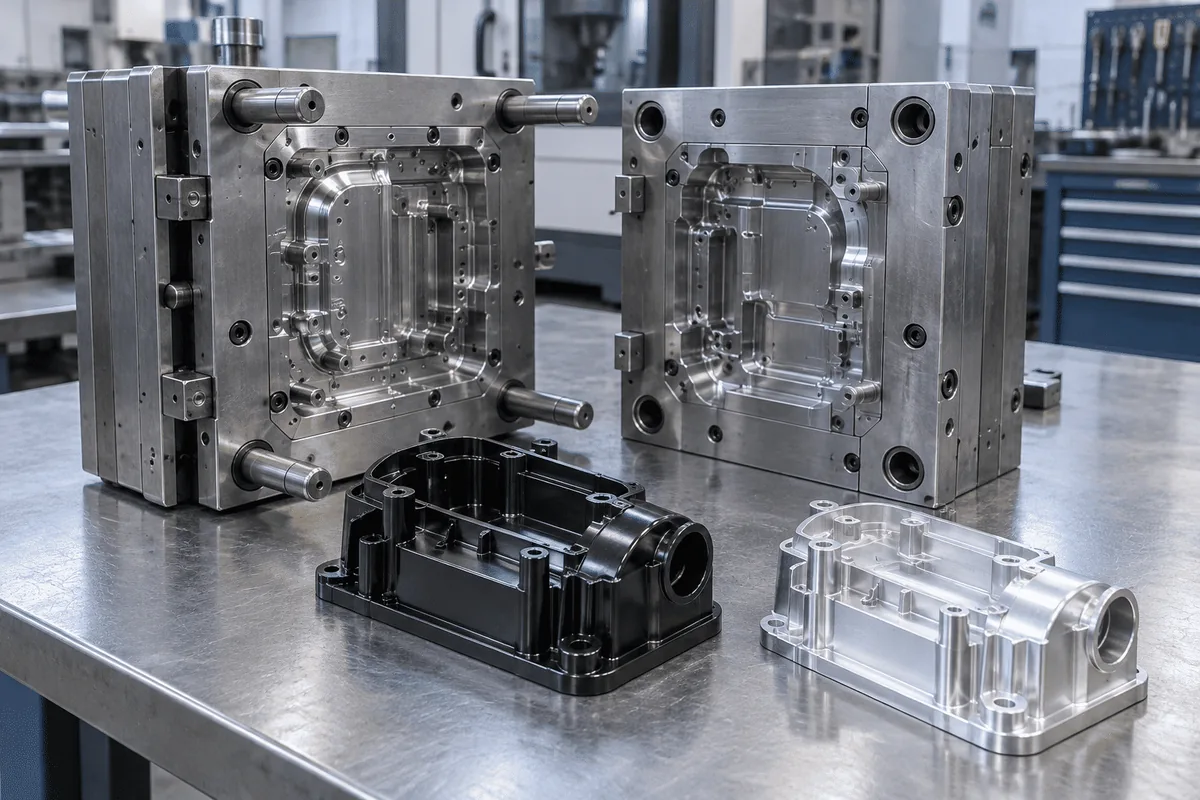
The question arrives at the end of a prototype review: "should we mould this?" It is usually answered by whoever is in the room. A machinist says no, a moulder says yes, and the decision gets made on intuition about volume rather than on arithmetic.
The arithmetic is not complicated. It is two lines, and it decides the answer for most parts within a hundred units.
Machining has a high marginal cost and no tooling. Moulding has a high fixed cost and a low marginal cost. The break-even is the quantity where the two totals cross.
Machining total = unit price × quantity
Moulding total = tool cost + (moulded unit price × quantity)
Set them equal and solve for quantity. The result tells you the volume above which the tool has paid for itself — and it is almost always lower than teams expect, and higher than moulders imply.
Take a palm-sized ABS enclosure, roughly 120 × 80 × 30 mm, with simple geometry and no undercuts.
| Quantity | Machining total | Moulding total | Cheaper |
|---|---|---|---|
| 10 | $450 | $7,032 | Machining |
| 50 | $2,000 | $7,160 | Machining |
| 100 | $3,600 | $7,320 | Machining |
| 200 | $6,600 | $7,640 | Close |
| 300 | $9,300 | $7,960 | Moulding |
| 1,000 | $28,000 | $10,200 | Moulding |
Break-even sits near 220 units. Above it, moulding wins decisively; below it, machining wins on total cost even though the unit price is eight times higher.
The break-even is not a property of the part. It moves with five variables, and understanding them is what turns a rule of thumb into a decision.
Tool cost scales with part size (projected area), number of cavities, surface finish requirements, and whether the design needs slides or lifters. Each side action adds roughly $800–$2,500. A single-cavity aluminium bridge tool can cost 40–60% of a steel production tool and delivers parts in 3–5 weeks instead of 6–10.
Every $1,000 removed from tool cost pulls the break-even down by roughly 30–40 units for this example.
If the machined part is simple — a flat plate with a few pockets — machining stays competitive much longer, because its unit price is low and there is no tooling to amortise. Complex machined parts with deep pockets and tight tolerances break even sooner.
Driven by part weight, cycle time, material, and cavity count. A two-cavity tool roughly halves the machine time per part but doubles the tool cost, which moves the break-even up.
This is the variable teams underestimate most. Once the tool is cut, every engineering change is a tool modification measured in weeks. If your design is not frozen, the true cost of moulding includes the probability of a change multiplied by its cost — which can easily exceed the entire tool.
An aluminium bridge tool changes the shape of the decision entirely. With a $3,000 tool and $4.50 parts, the break-even for the same enclosure drops to roughly 75 units, and you get production-representative parts in a month while the design settles.
Even when the volume says mould, the geometry may say no — or say "not without another $5,000".
A design that was machined from solid usually has features that moulding cannot reproduce — sharp internal corners, thick sections, no draft. Converting it is a redesign, not a process swap, and that engineering time belongs in the comparison.
Three intermediate options are worth knowing:
Below roughly 150–300 units for a small part, machining or urethane casting is usually cheaper once tooling is counted. Above that, moulding wins quickly. With bridge tooling the threshold drops to around 75–100 units.
Steel tool: 6–10 weeks including T1 and T2 trials. Aluminium bridge tool: 3–5 weeks. Both assume a frozen design and a straightforward part.
Yes, and it is often the right plan — but design the part for moulding from the start (draft, uniform walls, no undercuts), so the moulded version is the same part rather than a redesign.
As a rough guide, 30–60% of the machined unit price for a comparable part at volume, driven mostly by cycle time and material. The gap narrows for very small parts, where machine time per cycle is short.
Yes. The tool is cut from a 3D model and the DFM review, gate location and cooling layout are all derived from it. A 2D drawing alone is not enough.
"A mould" is not one thing. The tool choice moves the break-even more than any other variable, and it is usually decided in a single conversation without a table.
| Tool type | Relative cost | Cavities | Life | Lead time |
|---|---|---|---|---|
| Aluminium bridge tool | 40–60% of steel | 1 | ~5,000–20,000 shots | 3–5 weeks |
| Steel, single cavity | Baseline | 1 | 100,000+ shots | 6–10 weeks |
| Steel, two cavity | 1.6–1.9× baseline | 2 | 100,000+ shots | 7–11 weeks |
| Steel, family tool | 2–3× baseline | 2–4 different parts | 100,000+ shots | 8–12 weeks |
A bridge tool exists for one purpose: to get production-representative parts into the market before the design and the volume are certain. It costs less, arrives sooner, and wears out. If the product succeeds, you pay for the steel tool later and write off the bridge tool as a market-testing expense.
A family tool moulds several different small parts in one cycle, which is efficient for a product with a set of related components — but it couples their production. If one part changes, the whole tool is affected.
A customer needed a machined aluminum heat-sink housing, roughly 90 × 60 × 25 mm, with fins and a machined sealing face. Volume was 400 units a year, steady, with a design revision every 12 to 18 months.
The break-even arithmetic suggested moulding at around 2,000 units — five years of production. But the sealing face and the fin geometry were the functional core of the part, and both were easier to hold in aluminum machining than in a moulded polymer with the required thermal conductivity. The part stayed machined.
The lesson is not that machining always wins below a threshold. It is that the break-even calculation answers a cost question, and the material property question can override it. Run the arithmetic first, then check whether the geometry and the physics allow the cheaper answer at all.
The tool is the visible fixed cost. Three others are usually omitted from the comparison and can change the answer.
None of these makes moulding wrong. They make the comparison honest. A tool at $7,000 with a $3 redesign-free assumption and one trial is a different decision from $7,000 plus 40 engineering hours plus two trials plus a $1,200 maintenance allowance.
Write down two numbers: the tool cost and the difference in unit price. Divide one by the other and you have the break-even, usually within a hundred units. Then check the geometry, add the cost of a design change, and compare at the volume you will actually order — not the volume you hope for.
We quote machining and moulding on the same RFQ so the comparison is made against your volume rather than against our equipment list. See our injection moulding capabilities, or send a model and a quantity and we will run the arithmetic with you.

