


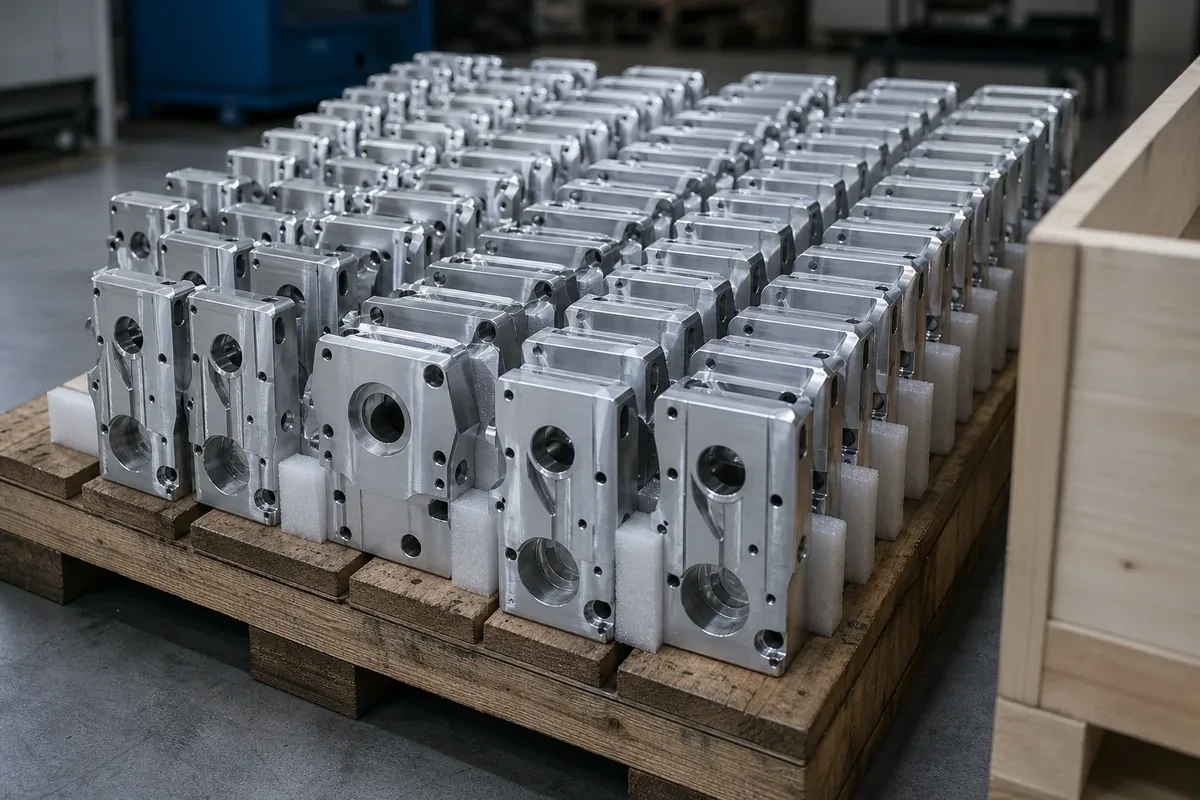
A buyer sends an RFQ for 20 machined aluminum housings and receives a lead time of "10 days". Three weeks later the parts ship. Nothing went wrong in the machining — the delay was baked into the answer, because "10 days" referred to machine time and everyone assumed the other steps were free.
Lead time is a sum, not a number. It is worth breaking down, because knowing which part of the chain is long tells you whether to negotiate, redesign, or change strategy entirely.
| Stage | Typical duration | What drives it |
|---|---|---|
| Quote and DFM review | 0.5–2 days | Drawing completeness, shop workload, whether the part needs a feasibility study |
| Material procurement | 0–10 days | Stock on hand vs mill order; grade and form availability |
| Programming and fixturing | 0.5–3 days | Feature count, CAM complexity, need for custom soft jaws |
| Machining | 1–10 days | Cycle time × quantity ÷ available machine hours |
| Finishing (subcontracted) | 2–7 days | Anodize, passivate, coat, heat treat; batch scheduling at the finisher |
| Inspection and packing | 0.5–2 days | FAIR scope, CMM queue, documentation |
Add freight: 3–5 days by air to Europe or North America, 25–35 by sea. The stage that dominates is usually not the one people assume.
At five pieces, the machining time is trivial and everything else dominates. Setup, fixturing and first-article inspection happen once regardless of quantity, so a 5-piece order is almost pure overhead. At fifty pieces, machining starts to matter but setup is amortised. The curve is not linear in either direction.
There is a second effect: small orders get scheduled into gaps. A shop running a 2,000-piece production job will not stop a machine for five units, so your five pieces wait for a window — and windows appear at unpredictable times. Large orders get planned; small orders get squeezed in.
This is why a supplier who quotes "3 days" for a prototype and "4 weeks" for 500 pieces is not being inconsistent. They are describing two different scheduling regimes.
If the material is on the shelf, procurement takes hours. If not, three things can happen:
This is the single most common cause of a lead time that slips without anyone being at fault. If your part needs 7075-T651 in a thickness the distributor does not carry, no amount of chasing the machine shop will help. The fix is at the drawing stage: choose a grade and form that is commonly stocked, or accept the procurement time and plan around it.
Ask the question directly in the RFQ: "is the material in stock, and if not, what is the mill lead time?" A supplier who answers in one line has checked. One who answers "yes, no problem" has not.
Anodizing is usually subcontracted, and the anodizer runs batches. Your 20 parts may wait two days for a batch to fill, spend a day in the line, and a day coming back. That is four days added to a plan that assumed finishing was an afternoon.
Three practical consequences:
If the schedule is tight, the highest-leverage question is not "how fast can you machine" but "when does your anodizer run this finish next".
Ask for 5 pieces in 5 days and the remainder in three weeks. Most shops will do this, and it lets you start assembly and testing while the bulk is still in production. The cost premium is usually small — a second setup — and the schedule benefit is large.
If the parts are functional before anodizing, take delivery of the machined parts and have finishing done locally or in a later batch. You lose some protection and appearance, but you gain the finishing queue time back.
A full FAIR on every dimension takes time on a CMM. If the part has 60 dimensions and only 12 matter for the first build, a partial report on those 12 can be produced in a fraction of the time. This is a legitimate trade if you accept the remaining risk consciously.
Designing around 6061-T6 plate in a standard thickness rather than 7075-T651 in a special size can remove a week. It is a design decision, not a supplier one.
Shops prioritise against real deadlines. A customer who says "we need these by the 14th for a build" gets scheduled differently from one who says "as soon as possible". Vague urgency reads as no urgency.
When a supplier says "10 working days", ask three follow-ups:
A quote that answers all three is a plan. One that does not is an aspiration.
5–8 working days from drawing approval, including standard anodizing, if the material is in stock. Without finishing, 3–5 days. With a special material grade, add the mill lead time.
In our experience the three most common causes are: material not in stock, finishing queue at the anodizer, and drawings that were still being clarified after the PO. All three are visible before the order is placed if you ask.
Sometimes, and it usually buys scheduling priority rather than physics. Machining time cannot be compressed much, but a job can jump the queue. Finishing is the stage where money most reliably buys time.
For parts where the schedule matters more than the freight cost, yes. Air is typically 3–5 days door to door against 25–35 by sea. For a 20 kg shipment of machined parts, the difference is often a few hundred dollars against a week of program delay.
Plan backwards from your build date: subtract freight, finishing, machining, programming and material procurement, then add a week of buffer for the unexpected. For a 500-piece order with finishing, that usually lands at 6–8 weeks from PO.
Most lead-time pain comes from planning forwards — adding days to a purchase date — rather than backwards from the date the parts are needed on the line. The backwards method is mechanical and exposes problems early.
What remains is the latest date you can place the order. If that date is in the past, you have a decision to make — split the order, air-freight the first shipment, or accept a delay on the build — and it is far better to make that decision four weeks out than four days out.
The exercise also tells you where to spend money. If the critical path is material procurement, paying for expedited stock is cheap. If it is the anodizer's batch schedule, money can buy a slot. If it is machining, money buys almost nothing, because machine time is bounded by physics.
Lead time is quote time plus material plus programming plus machining plus finishing plus inspection plus freight. The stages that surprise people are material procurement and the finishing queue, and both can be checked with one question before you place the order.
We quote lead times by stage rather than as a single number, so you can see where the time goes and which parts can be compressed. See our machining capabilities, or send an RFQ and we will tell you the realistic date — including when it is longer than you hoped.

