


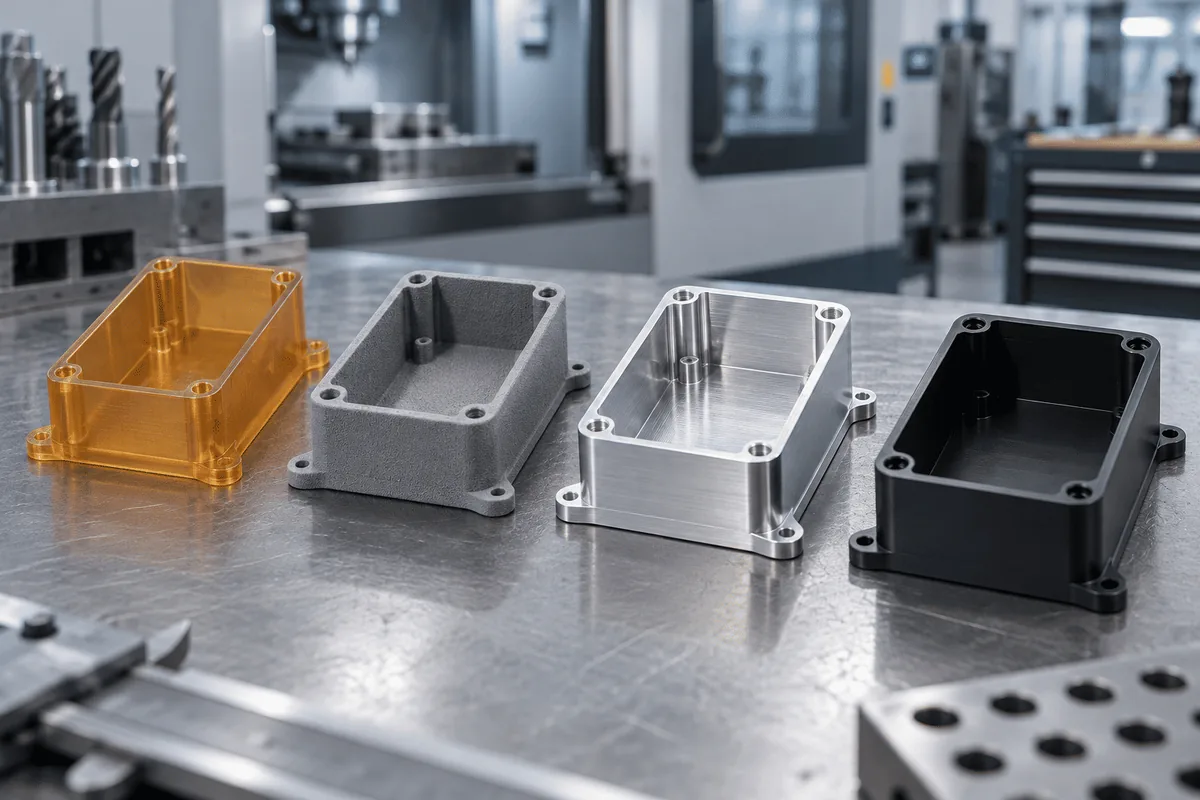
A prototype has one job: to answer a question. The problem is that teams often build the prototype first and decide what it is supposed to prove afterwards — and then choose the material and process before knowing whether the prototype needs to survive a drop test or simply look right on a desk.
Material choice for prototyping is not about which plastic is strongest. It is about matching the material's honesty to the question you are asking.
| What you are testing | Material honesty required | Process |
|---|---|---|
| Does it look right? | Low — appearance only | SLA resin, painted |
| Do the parts fit together? | Medium — dimensional | SLA or SLS, or machined |
| Does it survive handling and assembly? | Medium-high | SLS nylon, or machined |
| Does it carry load? | High — production material | CNC machined from the real material |
| Does it survive heat or chemistry? | High | Machined from the production polymer |
| Can it be moulded? | High — process, not just material | Tool trial, or moulded prototype |
The most expensive prototyping mistake is a cheap prototype that answers the wrong question — then a production run that fails on something the prototype never tested.
Stereolithography produces the smoothest surface and the finest detail of any additive process. Layer heights down to 25 µm make it possible to reproduce text, fine ribs and snap features that other processes lose.
Use it for: appearance models, form studies, master patterns for silicone moulds, and any part where the visual surface is the point.
Know its limits: standard resins are brittle. A thin snap arm printed in resin will work twice and break on the third actuation — and it will break differently from the same geometry in ABS or polycarbonate. Resin is also UV-sensitive; parts left in sunlight yellow and embrittle.
Tough and engineering resins exist and are much better, but they are still not the production polymer. If the question is "will this hinge survive 10,000 cycles", resin cannot answer it.
Selective laser sintering in PA12 produces parts with no support structures, good isotropy, and enough toughness for real handling. Living hinges work. Snap fits work, at least for a while. Threads can be formed directly.
Use it for: functional prototypes, small batches of end-use parts, duct assemblies, brackets that will be handled and dropped.
Know its limits: the surface is porous and slightly granular, which matters for sealing and for anything that must be cleaned. Dimensional accuracy is typically ±0.3 mm or ±0.3%, whichever is greater — good for fit checks, not for precision interfaces. And PA12 absorbs moisture, which changes dimensions slightly over time.
Glass-filled nylon (PA12-GF) raises stiffness and temperature resistance and is a reasonable stand-in for a glass-filled moulded part.
Machining a prototype from the production material is the only route that answers mechanical questions truthfully. A 6061-T6 bracket tested to failure tells you something a printed one cannot; a POM prototype runs on a real bearing surface the way the production part will.
Use it for: load-bearing parts, thermal or chemical exposure, seal interfaces, anything that will be tested to a specification rather than looked at.
Know its limits: cost per part is higher at quantity one, geometry is constrained by tool access, and a machined version of a part designed for moulding will have different residual stress and different failure modes. Machining also cannot reproduce the weld lines and anisotropic shrinkage of an injection-moulded part — so a machined prototype can pass a test the moulded part fails.
A printed master is used to make a silicone mould, from which 10–50 polyurethane parts can be cast. Shore hardness and flexural modulus can be selected to approximate ABS, PP, or a rubber.
Use it for: pilot builds, field trials, trade show units, and any situation where you need 20 parts in a production-like material before committing to steel.
Know its limits: the mould degrades after 20–50 shots, dimensional accuracy is lower than machining, and cast parts have different fatigue behaviour from moulded ones. It is a bridge, not a substitute.
If the production part is formed from sheet, prototype it from sheet. A bracket machined from solid to the same nominal dimensions will fit differently, because forming changes both geometry and residual stress. Laser cutting plus press braking gives you the real process with no tooling, typically in 3–6 days.
| Process | Typical lead time | Relative cost per part (quantity 5) | Material honesty |
|---|---|---|---|
| SLA resin | 2–4 days | Low | Poor |
| SLS nylon | 3–5 days | Low-medium | Moderate |
| CNC machined | 3–7 days | Medium-high | High |
| Urethane cast | 7–12 days | Medium | Medium-high |
| Sheet metal | 3–6 days | Low-medium | High (for sheet parts) |
For handling, assembly and low-load fit checks, yes — SLS nylon is a reasonable stand-in. For load, fatigue, heat or chemical exposure, no. Print geometry, machine function.
Urethane casting from a printed master, unless the part is flat or formed, in which case sheet metal is usually cheaper and more representative.
SLA can hold ±0.1 mm on small features; SLS is typically ±0.3 mm or ±0.3%. Both are looser than machining, which matters if the prototype is checking a press fit.
If the prototype's purpose is to answer a mechanical question, yes. A prototype in the wrong material answers a different question, and usually the answer is wrong.
You need to have answered the questions the prototype exists to answer. For a simple cosmetic part, a printed model and a DFM review may be enough. For anything with a mechanism or a load path, a functional prototype pays for itself.
How many prototypes you need is a separate question from what material they should be, and it is usually answered by default — usually "three" or "five", inherited from a previous project.
The useful framing is: how many distinct questions are you answering, and does each need its own part?
Above roughly 20 units, the cost curve changes shape: printing is still linear, but urethane casting from one master gets cheaper per part, and at 50 units a bridge tool starts to compete. That is the point at which the question stops being "which prototype" and becomes "which low-volume process".
An unfinished SLS part looks and feels like a prototype, which matters when the audience is a customer rather than an engineer. Three finishing options cover most needs: bead blasting for a uniform matte surface, dyeing for colour (black is standard and inexpensive), and sanding plus primer plus paint for an appearance-grade model. Each adds a day or two, and each changes the dimensions slightly — so measure before finishing if fit is being validated.
Printing answers geometry questions beautifully and mechanical questions poorly, and the gap is wider than most teams assume.
The practical rule: use printing to confirm that the geometry is right, then test the function in the material and process that will actually be used. If that means machining three parts in the production polymer before tooling, that cost is small compared with a tool modification after T1.
Decide what the prototype must prove, then choose the material that can prove it honestly. Resin for appearance, nylon for handling, machined production material for load and environment, urethane for pilot builds. The cheapest prototype that answers the real question is the cheapest prototype — the one that answers a different question is the most expensive thing in the program.
We run machining and sheet metal in-house and coordinate printing and urethane casting for the same program, so the process decision follows your question rather than our equipment. See our rapid prototyping capabilities or send a model with the test you need to pass.

