


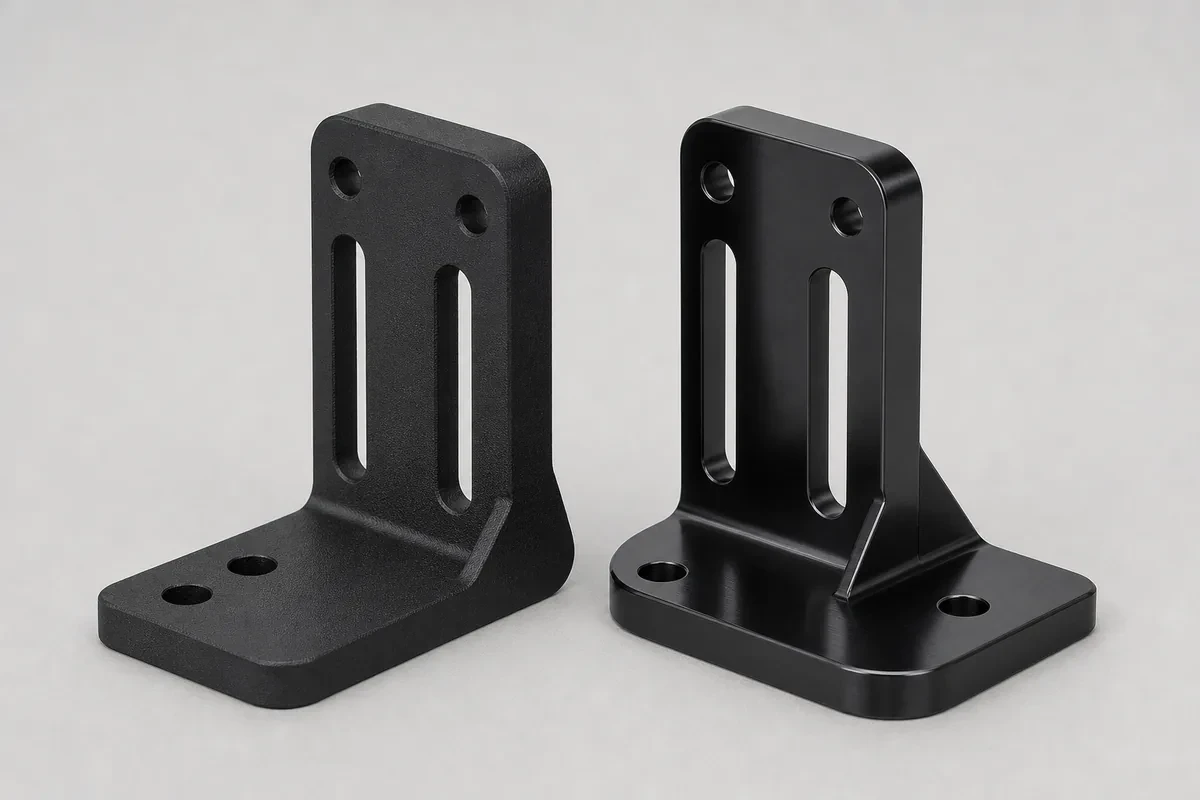
Anodizing and powder coating are both sold as "a finish", and buyers often treat them as interchangeable ways to get a coloured part. They are not close. One is a conversion of the metal surface itself; the other is a plastic layer glued on top. The difference changes the dimensional tolerance, the corrosion mechanism, the colour consistency and the price.
Anodizing is an electrochemical process that grows an oxide layer out of the aluminum itself. The aluminium is the anode in an acid bath, and the surface converts to aluminium oxide — hard, porous, and integral to the metal. Because the layer grows both into and out of the surface, roughly half its thickness is below the original datum.
Powder coating is electrostatically applied dry polymer powder, cured in an oven at 180–200 °C to form a continuous film. It sits entirely on top of the substrate and bonds by mechanical adhesion and, on some substrates, a conversion coating.
| Anodizing (Type II / III) | Powder coating | |
|---|---|---|
| Thickness | 5–25 µm (Type II), 25–50 µm (Type III) | 60–100 µm typical |
| Growth vs deposition | ~50% into the metal | 100% on top |
| Substrate | Aluminum only | Any conductive metal, plus plastics with special processes |
| Colour range | Limited (dyes), natural silver to black | Very wide, RAL matching possible |
| Hardness | Hard, up to 500 HV (Type III) | Soft, damages on impact |
| Abrasion | Good to excellent | Moderate, chips at edges |
| Corrosion | Good, but porous without sealing | Good barrier while intact; fails at chips |
| Dimensional impact | 5–50 µm per surface | 60–100 µm per surface |
| Electrical conductivity | Insulating (needs masking for grounding) | Insulating |
Both processes change dimensions, and neither is usually accounted for in the CAD model.
Type II anodize at 15 µm adds about 7.5 µm per surface, so a Ø10 H7 bore becomes roughly Ø9.985 — still inside H7 in many cases. Type III hard anodize at 40 µm adds 20 µm per surface, which takes that bore to Ø9.96, out of tolerance.
Powder coat at 80 µm adds 80 µm per surface: a Ø10 bore becomes Ø9.84, and a mating shaft will not enter. This is the single most common cause of "the parts fit before coating" complaints.
The fix is one of three, and the drawing must say which:
Whichever you choose, state the state explicitly: "Ø10 H7 after anodize" or "Ø10 H7 before anodize, mask". Otherwise the shop and the finisher each assume the other handled it.
Anodizing protects by converting the surface. The oxide is hard and adherent, but it is porous — the pores are what take the dye. Without sealing (hot water or nickel acetate), a dyed anodized part can bleed and corrode at scratches and cut edges.
Powder coating protects by barrier. While the film is intact, the substrate is isolated. The failure mode is mechanical: a chip or scratch exposes bare metal, and corrosion then creeps under the film, lifting it — a process called undercutting that looks much worse than the original damage.
Where each wins:
Anodized colour depends on the alloy, not just the dye. 6061 takes black dye evenly; 7075 comes out darker and slightly bronze, and the dye uptake is less uniform. A batch made from mixed alloys will not match, and the finisher cannot fix it — the metal is the variable.
Powder coat is far more consistent because the colour is the coating. The variables are film thickness and cure, both of which are controlled. For a product where two parts must match visually, powder coat is the safer choice.
Both finishes insulate. If a part needs a grounding path — an enclosure, a chassis, a bracket that carries earth — the contact area must be masked, or the finish removed afterwards. This is routinely forgotten until an EMC test fails.
Threaded holes are the other masking case. Anodize in a thread reduces the effective diameter and increases friction; powder coat can fill a small thread entirely. Standard practice is to mask threads, or to specify that the thread is chased after coating.
| Anodizing | Powder coating | |
|---|---|---|
| Setup / minimum charge | Lower, batch process | Higher, line and oven time |
| Per-part cost (small parts) | Low | Low to moderate |
| Lead time | 3–7 days, often batched by colour | 3–7 days |
| Cost of masking | Moderate, per feature | Higher, plugs and tape |
| Rework if defective | Strip and re-anodize (limited cycles) | Strip and re-coat (usually possible) |
For a simple aluminium bracket in black, anodize is usually cheaper and faster. For a steel enclosure in a specific RAL colour, powder coat is the only realistic option.
For outdoor or corrosive service, neither finish alone is always enough, and the two are sometimes combined. A duplex system — anodize followed by powder coat or paint — gives a hard, adherent base layer plus a barrier on top. It is common on architectural aluminium and on marine hardware, and it costs roughly the sum of both processes plus handling.
Pre-treatment is the part buyers never see and often the reason a finish fails early. Powder coating needs a clean, conversion-coated surface: degrease, etch, rinse, dry. Skip the conversion coating and adhesion depends on mechanical keying alone, which is why a coated part can peel in sheets after a year outdoors.
Anodizing needs its own preparation: a etch to remove the natural oxide, and a desmut step on alloys with heavy alloying elements. On 7075, a poor desmut shows up as a patchy, dark finish that no amount of dye will hide.
When a finish fails, ask which pre-treatment was used before blaming the coating. Most adhesion failures are pre-treatment failures, and the finisher usually knows.
Both finishes are hard to repair invisibly, and the cost of a defect depends on which one you chose.
Powder coat can sometimes be spot-repaired with a matched touch-up paint, which is acceptable on a non-cosmetic surface and visible on a visible one. Proper rework means stripping the whole part — usually by chemical or thermal stripping — and re-coating, which is feasible but costs a full cycle and risks dimensional change on a thin part.
Anodize cannot be patched. A scratch that goes through the oxide cannot be re-anodized locally; the part either goes back through the full process (strip, re-anodize, re-dye) or is accepted with a mark. Repeated stripping is limited, because each cycle removes a little aluminium.
The design consequence is simple: put the finish where it will not be damaged in assembly, and specify masking on the faces that will be handled. A finish that survives the factory is worth more than one that looks better on arrival.
You can, but there is little point — the anodize adds cost and the powder coat hides it. It is sometimes done for extra corrosion protection on outdoor parts, with a conversion coating rather than anodize as the primer.
Clear anodize darkens aluminium slightly and gives it a metallic sheen. On 7075 it produces a noticeably darker, warmer tone than on 6061. That is why colour matching across alloys fails.
Both work. Powder coat gives better colour retention and a wider palette; anodize gives better abrasion resistance and does not chip. In coastal environments, anodize with sealing or a duplex system is the more durable choice.
No — the oxide layer must be removed first, and welding through anodize produces porosity and contamination. Weld before finishing, always.
Usually a different alloy heat or a different dye bath concentration. Anodizers batch by colour, and small runs can drift. If colour is critical, specify a master sample and require approval against it.
Aluminium + wear resistance + tight tolerance = anodize, with masking specified. Any metal + specific colour + hiding surface variation = powder coat, with masking and thread protection specified.
In both cases the dimensional change is the thing that breaks assemblies, and the drawing has to state whether the tolerance applies before or after finishing. The broader treatment of surface specification is in our surface finish guide, and the tolerance implications are covered in the tolerance guide.
