


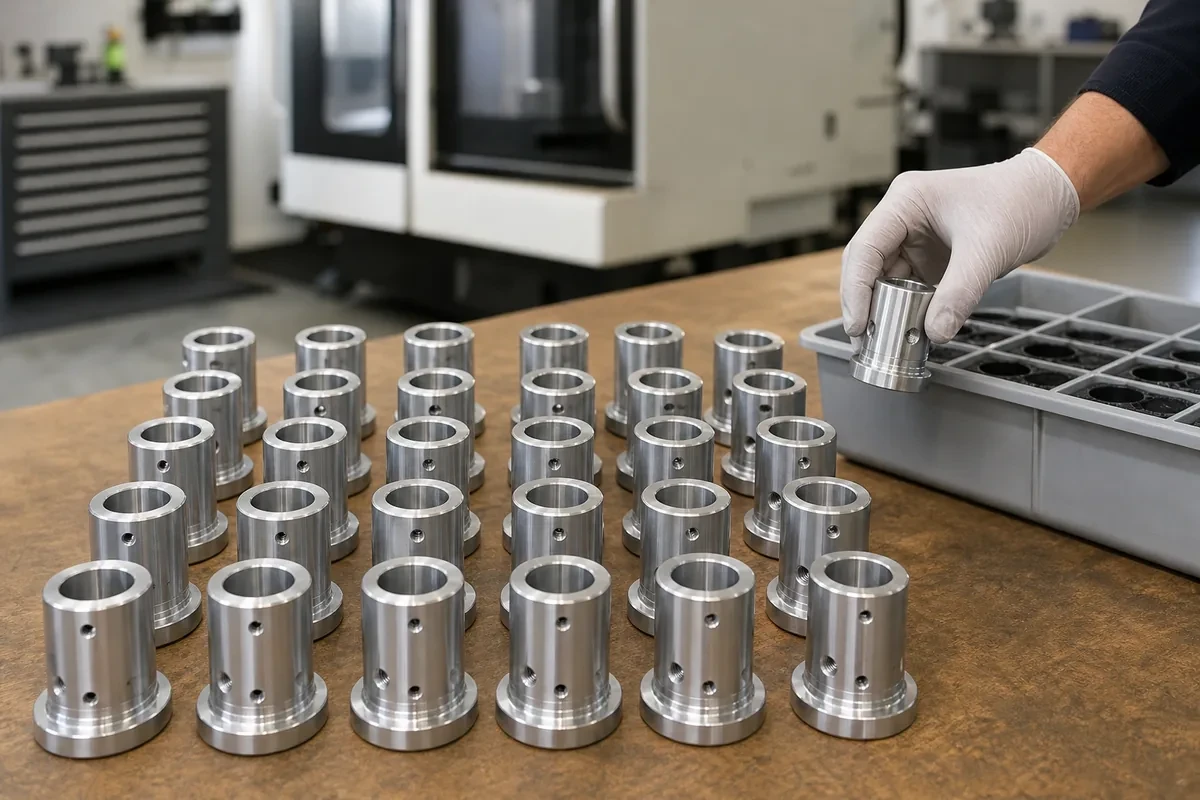
Low-volume machining is not small-volume production. A run of 30 parts does not behave like a run of 3,000 with the numbers divided down — it behaves like a different business, with different costs, different risks and different things that go wrong.
Most buyers discover this when a quote for 25 pieces comes back at 60% of the price of 25 times one piece. The setup did not shrink; it simply stopped dominating.
On a machined part, cost splits into three buckets:
At 1 piece, one-off is 70–85% of the price. At 25, it is 25–40%. At 500, it is under 10%. That is the whole story of why small runs feel expensive per unit, and why the first quantity break is always the steepest.
| Quantity | One-off share | Typical price index |
|---|---|---|
| 1 | 75–85% | 100 |
| 5 | 45–55% | 28 per part |
| 25 | 25–35% | 9 per part |
| 100 | 12–18% | 4.5 per part |
| 500 | 5–8% | 3.2 per part |
Those indices assume a part with roughly 20 minutes of cycle time. The shape of the curve matters more than the exact numbers: most of the saving happens in the first 25 pieces.
A low-volume order occupies a machine for a disproportionate share of its capacity. Setting up, proving out and inspecting 25 parts may take as long as running 400 — the machine is busy for a day either way, but the revenue is 6% of it.
That is why shops with full order books quote small runs high, and shops with capacity quote them competitively. It is also why a small run placed at the wrong moment can drift to the back of the queue: there is no penalty for delaying a $600 order when a $40,000 one is waiting.
Practical consequence: if your volume is 20–50 pieces a year and repeat, say so. A shop that sees a recurring order treats the setup as an investment rather than a cost.
A production fixture is designed to hold the part rigidly for thousands of cycles and to load in seconds. A low-volume fixture is a vise and a set of soft jaws. That is fine for ±0.05 mm and usually not fine for ±0.01 mm on a thin part, because the clamping varies between setups.
If the part needs tight tolerance at 25 pieces, expect to pay for a real fixture anyway — the shop will build it because there is no other way to hit the number.
At 500 pieces, a shop may run a CMM program on every tenth part. At 25, it runs a full first article on part one, then checks key features. That is a reasonable plan, and it is worth agreeing it in writing before the run rather than after.
At 5,000 pieces the shop buys material to a mill order with a known heat number. At 25, it cuts from whatever bar is on the rack — possibly a different heat than last time, with slightly different machinability and, for aluminium, slightly different anodized colour.
For cosmetic parts, this matters. If colour must match a previous batch, specify "same heat / same mill lot" and expect a material premium plus a lead time.
Small runs are not a compromise — for some parts they are the correct answer, and the cost comparison against tooling is not close:
Yield on first article. On a run of 500, scrapping ten parts is noise. On a run of 25, scrapping three is a 12% loss and a schedule slip. Ask what happens if the first article fails — good shops absorb it within reason, and it should be discussed before the order.
Queue position. Small orders slip. Build a buffer into the promised date rather than assuming the quoted lead time is firm.
Consistency between runs. Two runs of 25 six months apart may come from different material heats and different operators. If the parts must interchange across batches, say so and ask for a retained first article from each run.
Small runs fail on paperwork more often than on machining. With 500 parts, a missing inspection record is a gap in a sample. With 25, there is no sample — the record is the only evidence.
Three documents are worth asking for on any low-volume order:
Ask for these in the RFQ and expect them to be priced. A supplier who provides a full FAIR on 25 parts for free is either very efficient or not measuring much.
One order of 25 is not always better than two orders of 12 and 13. Splitting makes sense in three situations, and costs money in the rest.
What splitting costs: a second setup, a second first-article inspection, and a second shipment. On a part with 20 minutes of cycle time, that is typically 8–15% more in total — worth it for design risk, not worth it for convenience.
Roughly 1–250 pieces for machined parts. Above that, the economics start to invite comparison with casting or moulding, which have their own tooling thresholds.
Yes, for the same process and part. The only exception is when a smaller quantity allows a simpler process — for example, machining instead of investing in a fixture that only pays back at 500 pieces.
Only if you are honest that it is production. A shop that prices 25 pieces as a prototype will quote the same way for the next 25, and you will not build a supply relationship. Say "this is a first production batch of 25, with 100 more expected" and the quote changes.
Order 5–10% over on the first run of a new part. It is cheaper than a second setup for three parts, and it gives you samples for testing.
Because at that point you are paying for machine time and setup, not for parts. The marginal cost of five more units is small; the fixed cost does not care.
Low volume is a setup-cost business. Almost everything you can do to reduce price is a way to reduce setups, tighten less, standardise material, or promise a repeat.
If the part will be made 20 times a year for five years, it is not really low volume — it is a small recurring order, and it should be quoted as one. The full cost structure behind a quote is in our line-by-line breakdown, and the point where machining stops being the right process is covered in the break-even analysis.
