


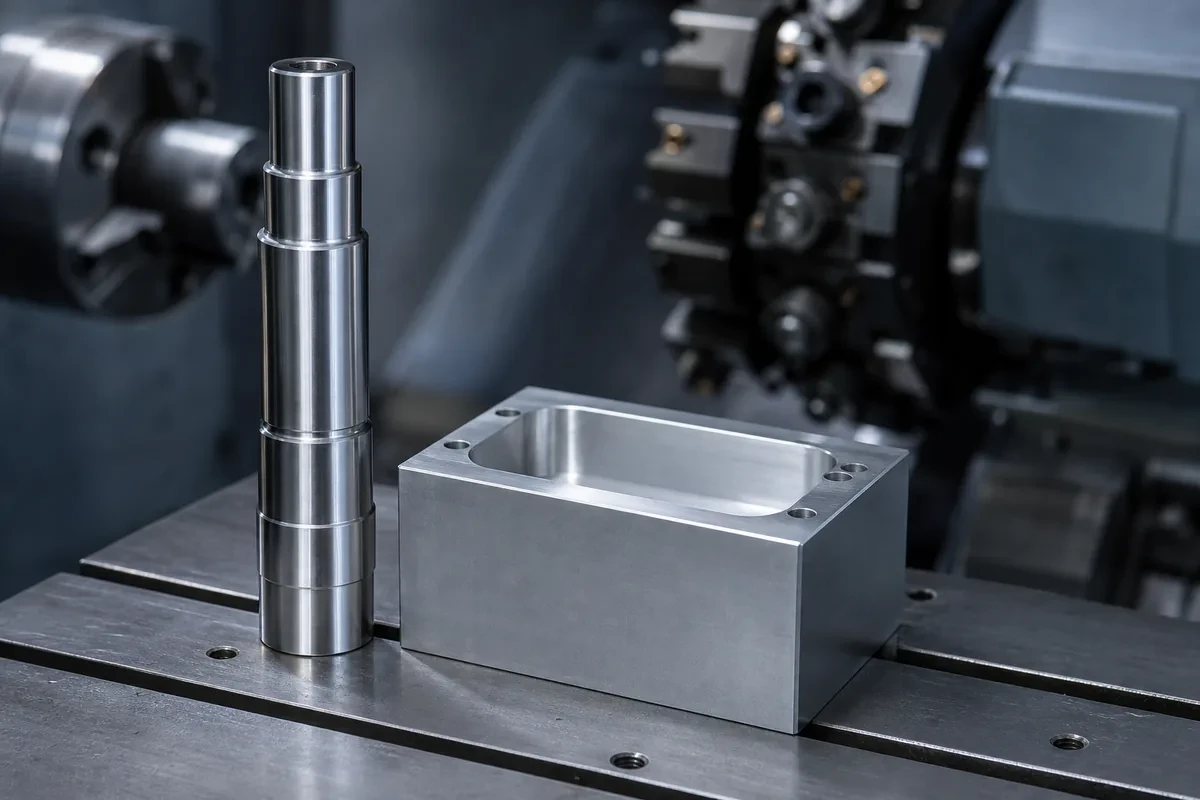
Turning and milling are the two foundational subtractive processes, and the choice between them is usually obvious — until it is not. A part with a turned body and milled flats, or a milled part with a single precision bore, sits in the overlap, and the decision then affects price, tolerance, and how many setups the job needs.
The short version: turning rotates the workpiece, milling rotates the tool. The long version is about which features your part is built around.
On a lathe, the workpiece spins and a stationary (or slowly moving) tool removes material. This is inherently good at producing surfaces of revolution: cylinders, cones, faces, grooves, threads, tapers. The part is round, and everything that follows from roundness is cheap.
On a mill, the tool spins and the workpiece is stationary (or indexed). This is inherently good at producing prismatic geometry: flats, pockets, slots, holes on faces, contours. The part is boxy, and everything that follows from flatness and squareness is cheap.
The cost difference is not about machine hourly rates, which are similar. It is about how much of your geometry the process produces naturally versus how much it has to fight for.
Ask: is the part fundamentally a body of revolution with features added, or a prismatic block with holes?
The economic consequence is significant. A cylindrical part with four flats machined on a mill requires two setups and a fixture to hold a round thing while you cut flats on it — the classic four-jaw or V-block problem. The same part on a lathe with live tooling is one setup, and the flats are positioned relative to the axis by the machine rather than by an operator with a dial indicator.
| Feature | Better on lathe | Better on mill |
|---|---|---|
| External cylinder, taper, groove | Yes — natural | Requires rotary table or 4th axis |
| Threads (external or internal, on axis) | Yes — single point or die head | Thread mill, slower |
| Faces perpendicular to axis | Yes — one pass | Requires setup change |
| Flats and slots on a round body | Yes with live tooling | Yes, but needs fixturing |
| Pockets and contours on a flat face | Awkward | Yes — natural |
| Hole patterns on multiple faces | Difficult | Yes |
| Thin discs and rings | Yes — low distortion | Difficult to hold |
| Large flat plates | Not practical | Yes |
For small, slender parts — under roughly 32 mm diameter with a length-to-diameter ratio above 3 — a Swiss-type lathe is the correct machine, not a conventional lathe. In a Swiss machine the bar stock slides through a guide bushing and the tools work close to the support, so deflection is minimal even on long, thin parts.
The tell is the part: a Ø6 mm pin 80 mm long is a Swiss job. The same pin on a conventional lathe will deflect and chatter, and the shop will either run it slowly or refuse it. If your design has slender turned features, ask whether the shop has Swiss capability — it changes what is economically possible.
A mill-turn machine combines a lathe spindle with a milling spindle and often a second turret. It exists for parts that need both, and its value is not speed but elimination of setups.
Consider a hydraulic manifold body: turned outside diameter, bored through, cross-drilled ports at several angles, milled mounting flats, tapped holes. On separate machines this is four to six setups, with the positional relationship between the ports and the flats depending on fixturing each time. On a turn-mill it is one setup and one datum.
The trade-off: turn-mill hourly rates are higher and programming is more involved. Below roughly 20 pieces of a moderately complex part, the setup saving usually wins. At high volume of a simple part, dedicated machines win on cycle time.
Both processes can hold ±0.01 mm on a good machine. The differences show up in specific characteristics:
The practical rule: put features that must relate to each other in the same setup, and choose the process that lets you do that.
Two quotes for the same part, one from a lathe shop and one from a mill shop, can differ by 40% — and the difference is legible if you know what to look for.
A lathe quote for a prismatic part will usually include a fixture line or an unusually high setup, because the shop has to solve the holding problem. A mill quote for a turned part will show extra setups and often a note about concentricity. Neither is wrong; both are telling you the part does not match the machine.
If you receive quotes with a wide spread, the useful question is not "why are you expensive" but "which machine did you plan to run this on". The answer explains the number, and sometimes reveals that the cheaper quote is planning a process that will not hold the tolerance.
Yes, with a rotary table or 4th axis, but the setup is more involved and the roundness depends on interpolation rather than on the spindle. For anything substantially cylindrical, a lathe is cheaper and more accurate.
With live tooling and a C-axis, a lathe can mill flats, slots and cross-holes on a round body. It cannot practically make a large flat plate — the work envelope and fixturing do not suit it.
Both hold ±0.01 mm. Turning is better for roundness and concentricity on axis; milling is better for flatness, squareness and position across faces. The gap appears when features must relate across setups.
Not always. It is better when setups dominate the cost — typically low to medium quantity of a part with features on multiple faces. For high volume of a simple part, dedicated machines usually win on cycle time.
Look at the dominant feature. If most of the part is a surface of revolution, it is a turning job. If most of it is flat faces and pockets, it is a milling job. If both, ask for a turn-mill quote as well — the comparison is often surprising.
The process choice is often decided less by cycle time than by how the part is held. Fixturing is invisible on a drawing and it is frequently the largest single line in a quote for a new part.
A prismatic block on a mill sits in a vise. That is nearly free. The same block on a lathe needs a four-jaw chuck, indicated in, or a custom fixture — an hour of setup that is repeated on every batch.
A cylindrical part on a lathe sits in a chuck. That is nearly free. The same part on a mill needs a V-block or a custom cradle, and every flat you cut requires re-indicating the axis.
Three fixturing situations are worth recognising early:
The practical takeaway: when comparing a turning quote and a milling quote for the same part, ask what each includes for fixturing. A quote that omits it is not cheaper — it is incomplete, and the difference appears later as a setup charge or a longer first-article cycle.
Turning for round, milling for boxy, turn-mill when both and quantity is low. The real cost driver is not the process but the number of setups it takes, so design features to be reachable from as few directions as possible — and ask which machine will run your part, because that answer explains the price better than any rate comparison.
We run lathes, mills and turn-mill centres in one shop and quote against your geometry rather than against machine availability. See our CNC machining capabilities, or send a model and we will tell you which machine should run it.
