


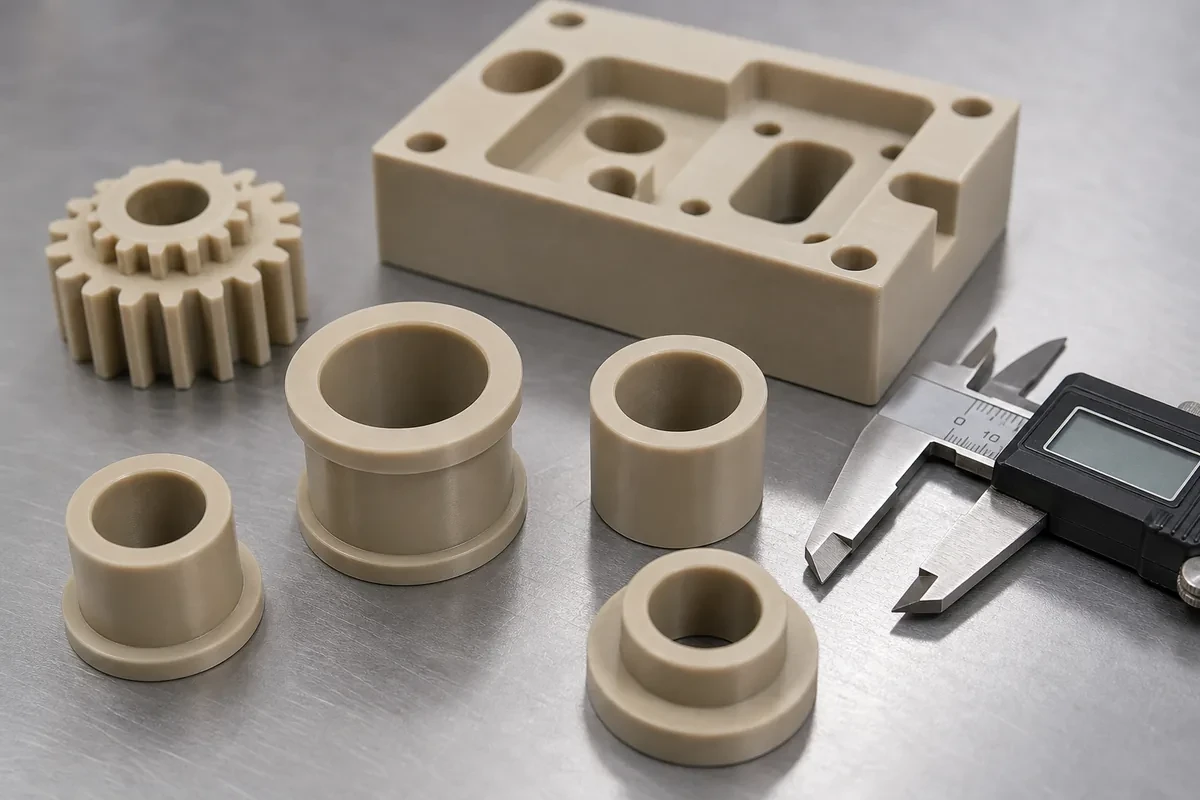
PEEK is the plastic engineers reach for when metal is too heavy and ordinary plastics are too weak or too hot. It machines well in the right conditions and badly in the wrong ones, and the failure modes are expensive: a PEEK part that has melted at the tool edge or absorbed moisture cannot be fixed.
This is what changes compared with aluminium or POM, and where the cost comes from.
PEEK (polyether ether ketone) is a semi-crystalline thermoplastic with a continuous service temperature around 250 °C and a glass transition at 143 °C. Unfilled, it is tough and chemical resistant; with 30% carbon fibre it approaches aluminium in stiffness at a fifth of the weight.
| Property | Unfilled PEEK | PEEK + 30% CF | Comparison |
|---|---|---|---|
| Density | 1.30 g/cm³ | 1.40 g/cm³ | Aluminium 2.70 |
| Tensile strength | 100 MPa | 220 MPa | 6061-T6 310 MPa |
| Modulus | 3.6 GPa | 21 GPa | Aluminium 69 GPa |
| Continuous use temp | 250 °C | 250 °C | POM 90 °C |
| Machinability | Good | Moderate (abrasive) | POM excellent |
| Relative material cost | 8–12× POM | 12–18× POM | — |
The cost is dominated by material, not machining. A 100 × 100 × 20 mm PEEK blank can cost more than the machining time on it, which changes the whole optimisation logic: scrap is expensive, and a mistake in setup is worth more than a few minutes of cycle time.
PEEK is machined with sharp, polished tools and high surface speed. Unfilled grades cut cleanly; carbon-filled grades abrade carbide, so coated or diamond tools and shorter tool life.
| Operation | Speed | Feed | Notes |
|---|---|---|---|
| Milling (unfilled) | 200–400 m/min | 0.05–0.15 mm/tooth | Sharp 2–3 flute, polished flutes |
| Milling (30% CF) | 100–200 m/min | 0.05–0.1 mm/tooth | Diamond-coated, expect wear |
| Turning (unfilled) | 150–300 m/min | 0.1–0.2 mm/rev | Positive rake, small nose radius |
| Drilling | 30–60 m/min | 0.05–0.1 mm/rev | Peck, clear chips, back the exit face |
Two rules override the table. First, **never let the tool dwell** — PEEK conducts heat poorly, so rubbing rather than cutting raises the local temperature past the glass transition and the surface smears. Second, **keep the part cool**: air blast is preferred over flood coolant, because PEEK absorbs almost no water but chips stick and re-cut.
The most common defect. A dull tool or a dwell leaves a smeared, gummy surface that cannot be polished out. It happens most on drilling, where chips pack the flutes and the drill rubs.
Fix: sharp drill, peck cycle, through-tool air, and reduce spindle speed rather than feed when the chips pack.
PEEK absorbs around 0.15–0.5% moisture depending on grade and environment. Machining wet stock and then letting it dry in service changes dimensions — a 0.4% change on a 100 mm part is 0.4 mm, which is enormous.
Fix: dry the blank before machining (150 °C for a few hours, per the supplier's data sheet), machine, and if the part needs long-term dimensional stability, anneal after machining.
Extruded PEEK bar carries orientation stress. Machine one side and it bows. The standard remedy is to remove material evenly from both sides, or to use annealed stock.
For thin parts, expect to rough, anneal, then finish — an operation the drawing never mentions and the quote should.
Carbon fibre filled PEEK can delaminate at the edges if the tool is dull or the feed is too light, because the fibres are cut rather than sheared. A light finish pass with a sharp tool is better than a heavy one.
PEEK burrs are tough and stringy, and they resist standard deburring. Sharp tools and a light chamfer in the program prevent most of them; hand deburring tends to tear rather than cut.
At 8–18× the cost of POM, PEEK has to earn its place:
Where it is not: a bracket that sees 60 °C and no chemicals should be POM or aluminium. PEEK there is a 10× cost with no function.
A typical 80 × 60 × 30 mm PEEK part at 20 pieces:
| Cost element | Share |
|---|---|
| Material | 45–60% |
| Machining | 25–35% |
| Annealing / stress relief | 5–10% |
| Inspection | 5–8% |
Because material dominates, the levers are different from metal: use the thinnest blank that covers the part, avoid a design that forces a large envelope, and do not scrap parts.
PEEK is rarely chosen in isolation. The real decision is usually between four materials, and the trade is rarely close on price.
| POM (Delrin) | PA (Nylon) | PEI (Ultem) | PEEK | |
|---|---|---|---|---|
| Continuous temp | 90 °C | 100 °C | 170 °C | 250 °C |
| Moisture absorption | 0.2% | 2.5% (high) | 0.25% | 0.15–0.5% |
| Chemical resistance | Poor to solvents | Moderate | Good | Excellent |
| Machinability | Excellent | Good | Good | Good |
| Relative cost | 1 | 1.2 | 4 | 8–12 |
The decision usually turns on two lines. If the service temperature is under 100 °C and there are no aggressive chemicals, POM is a tenth of the price and machines faster. If temperature reaches 150 °C, PEI is the cheaper step before PEEK, and it is adequate for many enclosures and insulators.
PEEK earns its premium in three specific places: continuous service above 200 °C, contact with solvents or fuels that attack PEI, and wear applications where a bearing grade outperforms bronze. Outside those, the money is usually better spent on a better design in POM.
PEEK is often specified as a universal upgrade, and it is not. Three limitations matter in design reviews:
It is not a low-friction bearing material by itself. Unfilled PEEK has a coefficient of friction close to nylon and will wear against steel under load. Bearing grades add PTFE, graphite and carbon, and those are what dry-running applications should specify — not the unfilled resin.
It has poor UV resistance. Long outdoor exposure yellows and embrittles it. For outdoor parts, a stabilised grade or a coating is needed, or the part should be a different material entirely.
It is expensive enough that small errors are visible. A scrapped PEEK part can cost more than a finished aluminium part. That changes the risk calculus: it is worth paying for a trial cut on scrap before running the real blank, and worth specifying extra stock so a mistake does not cost a week of lead time.
The material rewards careful process planning and punishes improvisation, which is the opposite of how POM behaves.
Annealing deserves a specific note because it is the step most often skipped. PEEK suppliers publish a ramp-and-hold cycle — typically heating at 40–50 °C per hour to a temperature above the glass transition, holding for several hours depending on section, then cooling slowly. Skipping it, or cooling quickly, leaves the part with locked-in stress that shows up as a crack days later. If a supplier cannot describe their annealing cycle, the part is probably not annealed.
Storage matters too. PEEK bar absorbs moisture from the air, and a blank that has sat in a humid workshop for a month will machine differently from one taken from a sealed bag. If the part has a tight tolerance over a long dimension, dry the stock, machine it, and keep the finished part in a controlled environment until it is assembled.
In shape, yes; in parameters, no. It needs higher surface speed, sharper tools and heat control. Treating it like aluminium produces melted surfaces and oversized holes.
Air blast is usually better. PEEK does not need flood cooling for heat, and chips tend to stick and re-cut when wet. Flood is acceptable if chip evacuation is the problem, but dry the part afterwards.
Moisture loss or stress relaxation. Dry the stock before machining and anneal after roughing if the part is thin or has asymmetric features.
If you need stiffness or dimensional stability over temperature, yes — it roughly doubles modulus. If you need impact strength or a smooth sealing surface, unfilled is better.
Yes, and it tolerates steam, gamma and EtO cycles better than most polymers. That is one of its main medical uses.
PEEK machines cleanly with sharp tools, high speed and heat control. The expensive mistakes are wet stock, dull tools and asymmetric material removal — all three cost more than the machining itself, because the material does.
Use it when temperature, chemistry or weight genuinely demand it; otherwise POM or aluminium will do the job for a fraction of the price. The general rules for machining plastics are in our DFM guide, and the metal comparison sits in the material selection framework.
