


Most machining quotes are guesses. Not because suppliers are careless, but because the RFQ they received left four or five decisions open, and each one had to be assumed. The shop picks a material, guesses an inspection level, assumes a tolerance block, and prices the most likely interpretation. Then the part arrives and someone discovers that "as machined" meant Ra 3.2 and the drawing wanted Ra 0.8.
A good RFQ is not a longer email. It is a short, structured set of answers that removes assumptions. This guide covers what to include, what a complete drawing package looks like, a copy-paste template you can use today, and how to compare the replies so you are not choosing between numbers that describe different scopes.
Seven items. Every one of them changes the number, and omitting any of them guarantees a follow-up email.
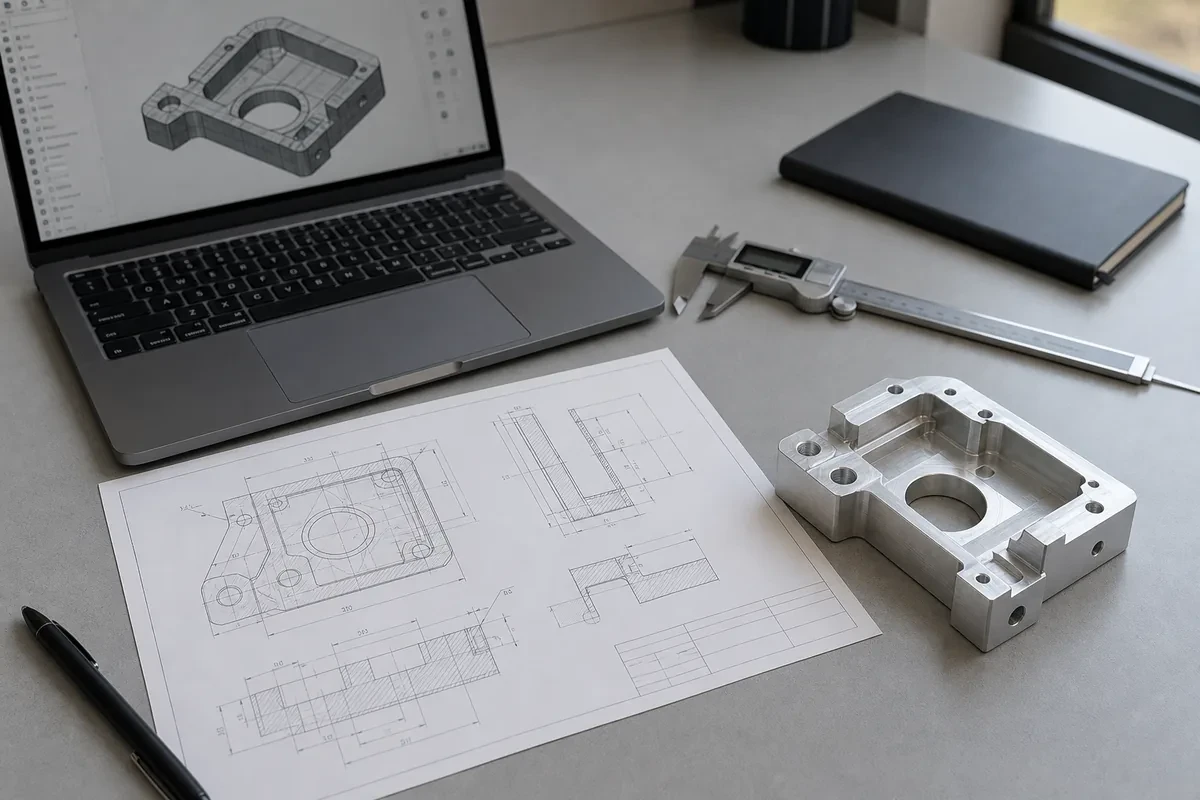
A 3D model and a 2D drawing. Both. The model defines geometry; the drawing defines tolerances, datums, finish and notes. One without the other is not a specification.
Material, grade and temper. "Aluminum" is not a material. 6061-T6 is. If the alloy is open, say so and ask for a recommendation — but say it explicitly.
Quantity, and a quantity ladder. One number produces one price. Three numbers produce a price curve, which tells you how the shop is amortising setup and where the volume breaks sit.
Finish and colour. Anodize type and class, plating, paint, or "none, as machined". Include which surfaces are cosmetic and which may be masked.
Inspection requirement. Dimensional report, FAIR, CMM data, material certificate, or none. This is a real cost line and it is the one buyers most often forget to specify.
Delivery date and destination. "As soon as possible" and a specific date produce different schedules. The destination determines packing and freight terms.
Commercial terms. Currency, Incoterms, payment terms, and whether tooling is charged separately or amortised into the unit price.
That is the whole list. It fits on one page, and a supplier who receives all seven can quote without a single clarifying question — which is also a useful test of your own RFQ.
The most common failure is a STEP file with tolerances implied by colour. The second most common is a PDF with no model, which forces the shop to rebuild geometry from dimensions — an invitation to error on anything with a curve.
STEP (AP214 or AP242) carries exact geometry. STL carries a triangle mesh, and a shop that receives one either rejects the RFQ or rebuilds the part. If your CAD exports only STL, fix that before sending anything.
Tolerances, datums, surface finish symbols, thread callouts, notes and the title block all live on the drawing. A model cannot express "Ø20 H7" or "Ra 0.8 on the sealing face". This is also where the tolerance decisions get locked in, and where an over-tight general block quietly doubles the price.
Put the revision letter in the filename and on the drawing, and state it in the email: "Drawing D01 Rev C, model D01 Rev C." When two suppliers quote a Rev B and a Rev C, you are not comparing quotes.
Machining has a fixed component — programming, fixturing, setup, first article — and a variable component of material and cycle time. Asking for five quantities exposes both, and it costs the supplier almost nothing to provide.
| Quantity | What it tells you |
|---|---|
| 1 | The true prototype cost, including all one-off work |
| 10 | Where setup is spread but still dominant |
| 50 | Typical low-volume production; the usual decision point |
| 250 | Whether the shop can run unattended or needs a second fixture |
| 1,000 | The volume break, and whether a different process should be considered |
The shape of the curve is diagnostic. A steep drop from 1 to 10 and a flat line after 50 means setup dominates and the process is right for you. A curve that keeps falling at 1,000 means the part is cycle-time driven, and at that quantity moulding may beat machining — worth knowing before you commit.
If you genuinely do not know the volume, give a range and a forecast: "50 now, 200 per year if the design holds." A shop prices a repeat customer differently from a one-off, and saying so is not a commitment.
Two lines on an RFQ cause more rework than any others.
Material grade. "Stainless steel" could be 303 (free machining, cheap, slightly less corrosion resistant), 304 (general purpose), 316 (marine and medical), or 17-4 PH (hardenable). The price difference between 303 and 316 on the same part can be 30%, and the functional difference is larger.
Finish ambiguity. "Anodized" does not specify Type II versus Type III, thickness, colour, or whether threads are masked. Type III hard anodize builds 25–50 µm per surface and will close a tight bore; Type II clear builds 5–15 µm and mostly will not. If the drawing is silent, one shop masks and another does not, and the parts are not interchangeable.
A useful habit: for every finish callout, write the functional reason in the note. "Type III hard anodize, 40 µm, wear surface on the bore, mask M6 threads." The shop can then flag a genuine conflict — for example, that a 40 µm build-up makes the stated bore tolerance impossible without pre-grinding.
Beyond quantity and material, these six items move a quote more than anything else. Each is worth checking before you send.
The general tolerance block. A title block of ±0.05 mm puts every dimension under inspection. ±0.1 mm with tight tolerances only where they function can cut 20–30% off a quote.
Thread callouts. "M6" is not a specification. M6×1 6H with a stated depth is. Without the class, a shop may cut a looser thread than your fastener needs.
Surface finish coverage. "Ra 0.8" applied to the whole part versus the one sealing face is a 30–50% finishing time difference.
Edge break. "Deburr all edges" is a hand operation and gets priced as labour. "Break sharp edges 0.3–0.5 mm" is a drawing note a shop can plan for.
Inspection level. A dimensional report with measured values, a FAIR, and a full CMM program are three different products. Pick one and say which.
Packaging and marking. Individual bagging, serial engraving, and custom labels are all real cost. They are also easy to omit and then argue about.
The block below is deliberately plain. Paste it into an email, fill it in, attach the drawing and model. It works with any supplier and forces every open decision into the open.
1. Part and revision
Part name / part number / drawing revision / model revision.
2. Process
CNC milling / turning / both / sheet metal / other. Note any operation you expect to be subcontracted.
3. Material
Alloy and temper, or "open to recommendation, must be corrosion resistant and weldable". State if a material certificate is required.
4. Quantities
1 / 10 / 50 / 250 / 1,000. Also state the expected annual volume if this is a first order.
5. Tolerances
Reference the drawing's general block, then list the critical characteristics and their tolerances explicitly. Add any GD&T datum scheme notes.
6. Finish
Type, class, thickness, colour, masking requirements, and which faces are cosmetic.
7. Inspection
None / dimensional report / FAIR with measured values / CMM program. State whether you need the report with the shipment or before it.
8. Delivery
Required date, destination city and country, and whether partial shipments are acceptable.
9. Commercial
Currency, Incoterm (EXW / FOB / DDP), payment terms, and whether tooling is a separate line.
10. Questions
"Please flag any feature you consider difficult or expensive to manufacture, and quote an alternative if a small design change would reduce cost."
Item 10 is the one most buyers omit and the one that pays for itself. A shop that tells you a 1 mm internal corner is driving 30% of the cycle time has given you a cost reduction you can act on — and has demonstrated that it read the drawing.
A few habits reliably slow quotes down or produce numbers you cannot compare.
A full assembly when you need one part. Sending a 200-part assembly to quote a single bracket means the shop has to dig the bracket out. Send the component, and say which assembly it belongs to.
A 2D PDF only, with curves. The shop will either rebuild the geometry or decline. Both cost you time.
"Best price for all quantities" with no quantities listed. It reads as a request to guess.
An NDA before any technical information. Reasonable for proprietary geometry, obstructive when you have not yet established whether the shop can make the part. Offer the NDA, do not require it as a precondition for a capability question.
Drawings marked "preliminary" with a request for a firm price. The price will be firm and wrong. Ask for a budgetary number instead, and say that is what you want.
Three quotes that look 40% apart usually differ in scope, not efficiency. Normalise before you judge.
| Check | Why it matters |
|---|---|
| Same revision quoted | A Rev B quote against a Rev C drawing is not comparable |
| Same material grade | 303 against 316 is a 30% material difference |
| Finishing included | Anodize is frequently quoted separately, or omitted |
| Inspection included | FAIR can add 5–15% and is often priced as an extra |
| Tooling treatment | Separate line versus amortised into unit price |
| Freight and duty | EXW against DDP is a different landed cost entirely |
| Lead time basis | From PO, from drawing approval, or from material arrival |
Once normalised, a persistent gap usually traces to one of five causes: a different machine, a different number of setups, a different material source, a different inspection level, or a shop buying work at a discount because it has capacity. The last one is legitimate and temporary — take it, but verify with a small first order before committing a production run.
The questions to ask are the same in every case: which machine, how many setups, what is included in finishing, what is included in inspection. The answers explain the gap in one round of email, and occasionally reveal that a quote is simply wrong.
Yes. The model defines shape; the drawing defines acceptance. Without a drawing, the supplier has to infer tolerances, and the inspection you receive will be against their inference rather than your requirement. If you have no drawing, say so and ask the supplier to propose tolerances — but then review and approve them in writing.
Two to four working days is normal for a machined part with a complete package. Same-day quotes usually mean a shop priced from experience rather than from the drawing — acceptable for simple parts, worth verifying for anything with tight tolerances. If a quote takes two weeks, the RFQ was probably incomplete.
Three to five is a sensible range. More than that and the good shops start to treat your enquiry as a price-check rather than an opportunity, which affects responsiveness. Fewer than three and you have no benchmark.
Say so and ask for their recommendation with the reasoning. A shop that can explain why it prefers 6082 over 6061 for your part is showing you its engineering, and that is more valuable than a number. Do not invent a tolerance to end the conversation.
For a first order, yes — material, setup, cycle time, finishing, inspection, tooling. It tells you which lever to pull if the price is too high, and it distinguishes a shop with a cost model from one applying a markup. Our line-by-line quote breakdown shows what a well-built quote looks like.
A complete RFQ answers seven questions: geometry, material, quantity, finish, inspection, delivery, terms. Add a quantity ladder and one open question — "what would you change to reduce cost?" — and you will get quotes that are comparable, faster, and closer to the truth.
The two habits that matter most: send both a STEP and a drawing with a revision letter, and specify finish and inspection explicitly rather than letting each supplier assume. Those two alone eliminate most of the back-and-forth that makes sourcing feel slow.
If you want a second opinion on a package before sending it out, our DFM checklist covers the design details that most often inflate a quote, and the lead time guide explains what a realistic schedule looks like once the order is placed.
