


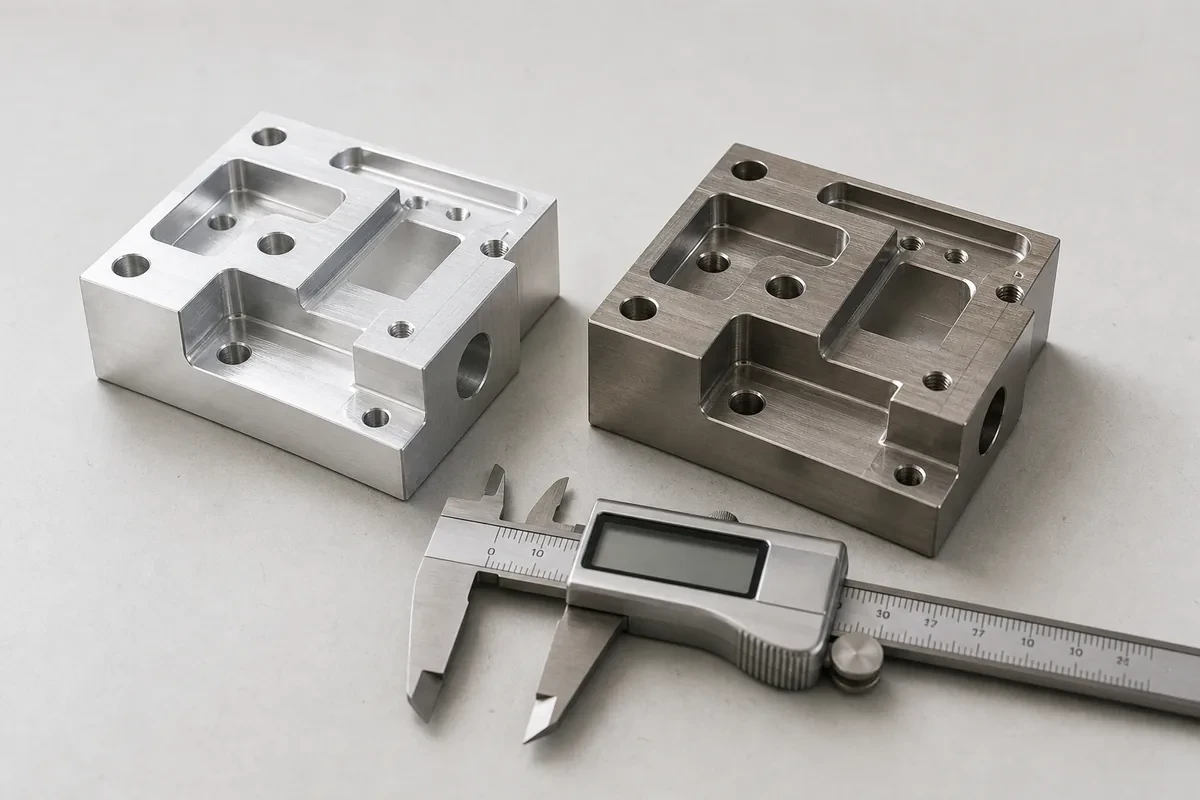
6061 or 7075 is one of the first decisions that surfaces at the RFQ stage, and it is usually made on a single sentence: "7075 is stronger." That sentence is true and almost useless. The two alloys differ by roughly a factor of two in price, by a noticeable margin in machinability, and in ways that decide whether your anodized parts match across a batch.
Choosing 7075 where 6061 would do adds cost without adding function. Choosing 6061 where 7075 is needed produces a part that passes first article and fails in the field. This guide sets out the five properties that actually decide the question, the cases where each alloy wins, and what belongs on the drawing so the shop does not have to guess.
Both are heat-treatable wrought aluminum, and both are usually supplied in T6 condition — solution treated and artificially aged. That is where the similarity ends.
6061 is an Al-Mg-Si alloy with small additions of copper and chromium. It is the general-purpose machining alloy: widely stocked in every bar and plate size, weldable, corrosion resistant, and inexpensive. Its temper is normally T6 or T651, the latter being stretched after quenching to relieve internal stress — which matters on thick plate where distortion during machining is a real risk.
7075 is an Al-Zn-Mg-Cu alloy, originally developed for aircraft structures. The zinc and copper give it strength comparable to some steels at one third of the weight. It is also less corrosion resistant, harder to weld, and considerably more expensive, because the alloying additions cost more and the mill supply is tighter.
| Property | 6061-T6 | 7075-T6 |
|---|---|---|
| Ultimate tensile strength | ~310 MPa | ~572 MPa |
| Yield strength | ~276 MPa | ~503 MPa |
| Elongation at break | ~12% | ~11% |
| Hardness (HB) | ~95 | ~150 |
| Density | 2.70 g/cm³ | 2.81 g/cm³ |
| Thermal conductivity | ~167 W/m·K | ~130 W/m·K |
| Corrosion resistance | Excellent | Moderate to poor |
| Weldability | Good | Not recommended |
| Anodized appearance | Clean silver, even dye uptake | Grey-bronze, uneven dye uptake |
| Relative material cost | 1.0 | 1.6–2.5 |
Those numbers are typical handbook values for small specimens. They describe the alloy, not your part — a machined section with a sharp internal corner behaves nothing like a polished test bar, which is why the strength advantage rarely translates at full ratio.
7075-T6 yields at roughly 500 MPa against 276 MPa for 6061-T6, an advantage of about 80%. In practice that buys one of three things:
Thinner sections at the same load. A bracket that needs 6 mm walls in 6061 may work at 4 mm in 7075, saving weight and sometimes envelope.
Higher safety factor in the same geometry. Relevant where a redesign is expensive and a material swap is not.
Fewer parts. The real win. A machined housing that replaces three welded steel components usually pays for the 7075 premium several times over in assembly labour and fasteners.
The advantage is smaller than the table suggests for three reasons. First, thin walls deflect before they yield, so stiffness — governed by modulus, which is essentially identical for both alloys — often controls the design. If your part fails a stiffness requirement, 7075 gives you almost nothing. Second, 7075 is notch sensitive: a sharp corner or a tool mark raises local stress more than it would in 6061, so the effective gain shrinks in parts with geometric discontinuities. Third, aluminum has no true endurance limit, and 7075's fatigue performance in a corrosive environment is worse than its static numbers imply.
The question to ask is not "which is stronger" but "what is the failure mode". Bending stiffness, deflection under load, thermal expansion, wear at a bearing surface, fatigue under vibration — each points to a different answer, and only the last two favour 7075 clearly.
6061 machines cleanly. Chips break predictably, built-up edge is manageable, and the alloy tolerates a wide range of speeds and feeds, which is why it is the material every shop quotes as a baseline. Surface finish comes easily, and thin features survive clamping better because the material is softer and more forgiving.
7075 is harder and stronger, which means higher cutting forces, faster tool wear and more heat at the edge. On a rigid part with thick sections this is a manageable rate increase. On a thin-walled part it becomes a process problem: the same wall that machines at 6 mm in 6061 will chatter at 4 mm in 7075 unless the shop reduces depth of cut and adds support.
The practical consequence shows up in quotes. A 7075 part typically carries 15–30% more cycle time and shorter tool life than the identical geometry in 6061. A buyer who expects the price difference to match the material price difference is usually surprised: the finished part can cost 35–50% more, because material is only part of the model.
Copper is what makes 7075 strong, and copper is also what makes it corrode. In salt air, in washdown environments, or in contact with a dissimilar metal, 7075 pits where 6061 would shrug it off. It is also susceptible to stress corrosion cracking when loaded in the short-transverse direction — the direction through the thickness of plate — which is exactly how a machined pocket loads the material.
The standard mitigation is the T73 temper, which over-ages the alloy to trade roughly 10% of its strength for substantially better stress corrosion resistance. If a part must be 7075 and must live outdoors, 7075-T73 is usually the correct call, and the drawing should say so rather than leaving the temper to the mill's default.
6061 has no such problem. Its oxide layer is stable, it anodizes into a coherent protective film, and it tolerates marine exposure. For anything that will see water, coolant, or a coastal installation, that alone can decide the question.
This is the issue that most often turns a 7075 decision into a customer complaint, and it is rarely discussed at the quoting stage.
Clear anodize on 6061 produces a clean, bright silver that takes dye evenly. The same process on 7075 produces a darker, grey-bronze tone, because the copper and zinc in the alloy end up in the oxide layer. Black dye on 7075 is visibly less even than on 6061, and the difference is most obvious on parts that sit next to each other in an assembly.
If a product has cosmetic aluminum parts that must match across a batch — a control panel, an enclosure, a fixture set — 6061 is the safe answer. If 7075 is required for strength and the part is visible, specify the finish explicitly: Type II black anodize with a stated colour tolerance, or a painted finish that covers the substrate entirely. Hard anodize (Type III) behaves the same way and adds its own dimensional build-up, which has to be allowed for in the drawing.
6061 welds readily with 4043 or 5356 filler, and the heat-affected zone loses roughly 40% of the T6 strength — a design fact, not a defect. If a welded 6061 assembly must carry load, either design for the annealed strength in the weld zone or plan a post-weld heat treatment.
7075 is not recommended for fusion welding. The zinc and copper segregate and the weld zone becomes both weak and corrosion-prone. If a 7075 assembly is required, it should be fastened or bonded. That constraint often decides the architecture: a welded frame in 6061 versus a bolted frame in 7075 is a different product, with a different cost and a different failure mode.
One more assembly detail: 7075 threads wear and gall faster than 6061 in repeated assembly, because the material is harder and less ductile at the surface. On any joint that will be opened more than a handful of times, specify a thread insert rather than trusting the parent metal — the same rule that applies to tapped holes in aluminum generally.
7075 bar and plate typically cost 1.6 to 2.5 times 6061 per kilogram, depending on size and availability. That ratio is a starting point, not the answer, because the finished part cost includes four other factors.
| Cost element | 6061-T6 | 7075-T6 |
|---|---|---|
| Material per kg | Baseline | 1.6–2.5× |
| Cycle time | Baseline | +15–30% |
| Tool life | Baseline | Shorter, more frequent changes |
| Scrap and rework risk | Lower | Higher on thin walls |
| Finishing | Predictable anodize | Colour matching effort |
At small quantities the premium is most visible: on 20 pieces, a 7075 part often quotes 40–60% above the 6061 version. At volume, the picture can invert, because 7075 lets you delete parts, fasteners and assembly steps. A single machined 7075 housing that replaces a welded 6061 fabrication is frequently cheaper in total even though the material line is higher.
There is also a logistics effect that gets ignored: a lighter part costs less to ship, and on air freight that can be 5–10% of landed cost. On a component shipped in quantity, the weight saving from thinner 7075 sections occasionally pays for the alloy premium on its own.
If neither alloy fits cleanly, four others are worth a look before the design is frozen:
6082-T6 — the European equivalent of 6061, slightly stronger, widely available in bar. Common on drawings from EU customers and often interchangeable.
2024-T351 — higher strength than 6061 with better fatigue performance than 7075 in some loading, but poor corrosion resistance and rarely the right answer outside aerospace.
7050-T7451 — a 7075 derivative with improved stress corrosion resistance and better behaviour in thick sections. The correct choice for large machined plates where 7075-T6 would crack.
MIC-6 cast tooling plate — not a strength alloy at all, but unmatched for flatness and stability. Fixture plates and inspection bases are usually MIC-6, not 6061.
Whichever alloy you choose, five items on the drawing prevent the most common misunderstandings:
Temper, explicitly. "6061-T6" or "7075-T651". T651 is stretched for stress relief and is the right call on plate thicker than about 25 mm; leaving the temper off invites whichever the mill shipped.
Grain direction where the part bends or carries fatigue load. Not every shop will honour it, but the ones that can will ask.
Anodize type, class and colour, with masking notes on threads and bores. Coating build-up of 10–25 µm per surface will move a tight bore out of tolerance if nobody planned for it — the same trap covered in our surface finish guide.
Material certificate requirement. If you need EN 10204 3.1, say so on the RFQ, not after delivery.
No weld repair, if that is the intent. Without the note, a cosmetic ding may come back welded, which is unacceptable on a 7075 part and unnecessary on a 6061 one.
It is stronger than mild steel by yield strength — roughly 500 MPa against 250 MPa — and comparable to some low-alloy steels. It is not stronger than quenched and tempered alloy steel, which reaches 1,000 MPa and above. "Strong as steel" is a marketing phrase, not a specification.
Yes, but the result differs from 6061. The copper content darkens the oxide and the dye uptake is less even, so a batch of 7075 parts will not match a batch of 6061 parts, and may not match itself across lots. For cosmetic parts that must match, use 6061 or paint over the anodize.
Three reasons: zinc and copper additions cost more than magnesium and silicon; 7075 is produced in smaller volumes with fewer mills rolling it; and it is harder to process, so mill lead times and minimum order quantities are less favourable. The machining cost increase adds to that.
For most machine frames, brackets, mounts and housings, yes — particularly when stiffness rather than yield governs. A 6061 part with sensible section depth and generous fillets usually outperforms a thinner 7075 part that deflects. Run the deflection calculation before assuming strength is the constraint.
No — it contains no iron, so it cannot rust. It does corrode, and faster than 6061 in wet or salty conditions, because of the copper. The white or grey powdery deposit on a 7075 part is aluminum oxide, not rust, and it is a warning sign rather than a cosmetic issue.
Choose 6061-T6 by default. It machines well, anodizes predictably, welds, resists corrosion, and is available everywhere. Move to 7075 only when a calculation shows the part needs the yield strength, when weight is worth more than the alloy premium, or when consolidating several steel parts into one machined component.
If you do move to 7075, specify the temper, expect a 35–50% part cost increase rather than a 2× material increase, plan the finish around its colour behaviour, and avoid welding it. Fasten instead.
The failure mode to avoid is choosing 7075 "to be safe". It is the more expensive answer, the harder one to machine, and the one that complicates anodizing — and in a stiffness-driven design it buys nothing at all. If you are unsure which governs your part, send the drawing and the load case; the material selection framework on this site covers how to decide between alloy families, and the tolerance implications of either choice are set out in our tolerance guide.
