


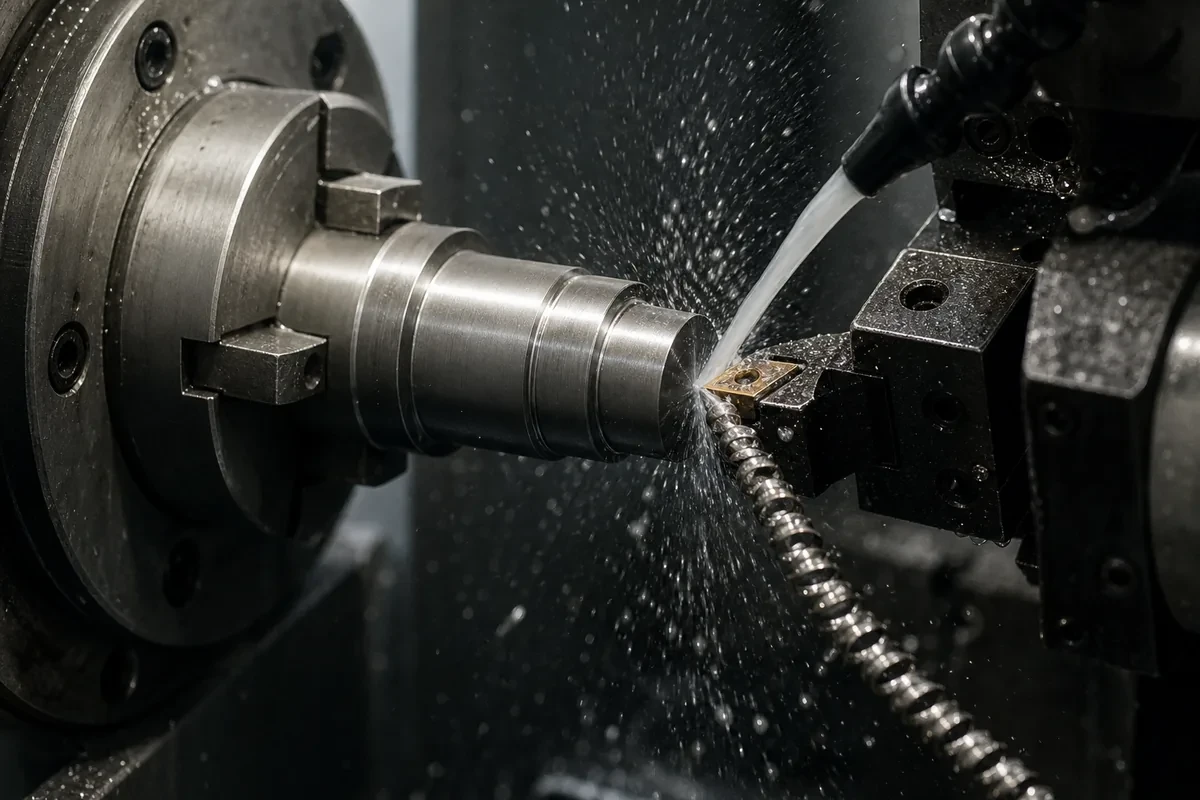
Inconel 718 is the material that turns a normal machining job into a project. It keeps its strength at 650 °C, resists oxidation and creep, and is used in turbine discs, rocket engine components, nuclear valves and high-pressure wellhead parts. It is also one of the least cooperative metals to cut: it work-hardens, it conducts heat badly, and it destroys tools that are not set up for it.
A part that costs $40 in 17-4 PH can cost $400 in 718 — not because the material is ten times dearer, but because the process is.
Four properties compound:
Carbide, fine grain, with a heat-resistant coating. AlTiN and AlCrN are common; PVD coatings outperform CVD for sharp edges. Positive rake geometry with a strong edge hone, and a chip breaker designed for nickel alloys.
| Operation | Surface speed | Feed | Notes |
|---|---|---|---|
| Rough milling (carbide) | 30–45 m/min | 0.08–0.12 mm/tooth | Radial depth 25–40% of diameter, axial 1–2× D |
| Finish milling | 40–60 m/min | 0.05–0.1 mm/tooth | Small step-over, climb milling only |
| Turning (rough) | 25–40 m/min | 0.15–0.25 mm/rev | Depth of cut below the hardened layer |
| Drilling (HSS-Co or carbide) | 8–12 m/min | 0.05–0.08 mm/rev | Peck, through-coolant essential |
| Tapping | 3–6 m/min | — | Thread mill instead of tap wherever possible |
These speeds feel absurdly slow next to aluminium. They are not conservative — running 718 at 80 m/min will destroy a $60 cutter in minutes.
Every pass must cut. A tool that dwells or takes a 0.02 mm depth of cut in work-hardened material generates heat and hardens the surface further. Keep the feed per tooth up and the radial engagement generous; a lighter pass is not a safer pass in 718.
Depth of cut should be at least 0.5 mm, and ideally deeper, so the edge is always in fresh material rather than skimming the work-hardened skin left by the previous pass.
Through-tool coolant at 70 bar is the single biggest tool-life improvement in 718. It breaks the chip, cools the edge and prevents built-up edge. Flood coolant at low pressure is much less effective.
Conventional milling in 718 produces a work-hardened, smeared surface and rapid flank wear. Every finishing path should be climb.
Tool life is measured in minutes, not hours. A shop quoting 718 will plan for several tools per part and will price them in. If a quote looks cheap, ask how many tools it assumed.
Rough with a large tool and a trochoidal path. Dynamic or trochoidal milling keeps radial engagement small and constant, which spreads heat and lets the tool cut rather than rub. It is slower per pass but far more predictable, and in 718 predictability is worth more than speed.
Leave 0.5–1 mm for finishing. More than that and the finish pass becomes a roughing pass in hardened material; less and the finish cannot clean up the roughing marks.
Minimise setups. Every re-fixture is a chance to cut into a hardened surface. Five-axis or multi-sided fixtures pay for themselves on this material.
Drill with care. Deep holes in 718 are the most common failure point — chip packing, then breakage. Peck, use through-coolant, and consider drilling undersize then boring.
718 is usually supplied in the annealed or solution-treated condition and aged after machining (720 °C for 8 h, then 620 °C for 8 h, typical). Aging causes shrinkage of roughly 0.04–0.08%, and distortion if the part is asymmetric.
The consequence for the drawing: decide whether tolerances apply before or after aging. If a bore must be H7 in the finished part, either machine it undersize and finish after aging, or accept that the aging will move it.
Stress relief before finish machining is common on thin or asymmetric parts: solution treat, rough machine, stress relieve, finish machine, age.
For an 80 mm diameter, 40 mm thick flange with a bore and eight holes, 10 pieces:
| Material | Material cost | Machining | Total index |
|---|---|---|---|
| 6061 aluminium | Low | Fast | 1.0 |
| 304 stainless | Low | Moderate | 2.5 |
| 17-4 PH | Moderate | Moderate | 4 |
| Inconel 718 | High | Very slow, high tool wear | 12–20 |
The multiplier is mostly machine time and tooling. A 718 part that takes 3 hours of spindle time where aluminium took 20 minutes is normal, and at $60–90/hour that is the whole cost.
Tool failure in Inconel is not random, and the wear pattern tells you which parameter is wrong. Learning to read it saves more money than any speed table.
The pattern to watch for is a change in the pattern. A tool that suddenly notches where it previously wore evenly is telling you a fixture moved or a batch of material is different — both worth investigating before the next part.
Inconel punishes any flexibility in the setup. A part that moves by 0.05 mm under cutting load will produce a tool that rubs on one pass and bites on the next — and rubbing is how work hardening starts.
Three practices are standard:
The cost of a fixture is small next to the cost of a scrapped 718 part or a weekend of broken tools, which is why experienced shops will quote a fixture on a first article even at low volume.
Coolant delivery deserves the same attention as tool selection. On a deep pocket, flood coolant from one nozzle never reaches the cutting edge, and the tool fails while looking correctly specified on paper. Through-spindle coolant, or a high-pressure jet aimed at the flank from close range, is what makes the parameter table achievable. If a shop says it machines 718 but has no high-pressure coolant, believe the equipment over the claim.
No, not practically. Dry machining generates edge temperatures that destroy carbide in seconds. High-pressure coolant is the standard.
Typically five to eight times the cycle time, and three to five times the tool consumption. Some geometries are worse.
Different. Titanium's problem is heat and chatter with a tendency to gall; 718's problem is work hardening and abrasion. Most shops find 718 slower but more predictable than Ti-6Al-4V.
Yes, but it needs a controlled procedure and post-weld heat treatment. For machined parts, welding is usually avoided because it introduces distortion and residual stress into a part that is already difficult to hold.
Work hardening in the hole, chip packing, or too high a speed. Thread milling avoids the problem entirely and is the recommended approach for anything above M6.
Slow speeds, heavy feeds, sharp coated tools, high-pressure coolant, climb milling and no rubbing. Those six rules are the difference between a 718 job that finishes and one that eats cutters and scrapped parts.
Budget for 12–20× an aluminium part and plan the heat treatment sequence before the first cut. The general rules for difficult materials are in our material guide, and the tolerance implications of post-machining heat treatment are covered in the tolerance breakdown.
