


AS9100 is the aerospace quality management standard, and "we are AS9100 certified" is the sentence a supplier puts in the first email. It is also the sentence buyers most often accept without checking, because verifying it properly takes an hour and the certificate looks official.
What the certificate actually tells you, what it does not, and the five things worth verifying before you place an aerospace order.
AS9100 (or EN 9100 in Europe, JISQ 9100 in Japan) is ISO 9001 with aerospace-specific requirements layered on top. The additions that matter to a buyer:
The standard is maintained by the IAQG, and certification is issued by an accredited certification body (CB). That last detail is where most of the verification work sits.
An AS9100 certificate says the supplier's quality management system conforms. It does not say:
It also does not distinguish between a supplier that builds aerospace parts daily and one that obtained the certificate to win a single programme and has not maintained the discipline since. Both hold valid paper.
The IAQG maintains the OASIS database, where certificates can be looked up by supplier name and certificate number. Check:
A PDF certificate is trivially editable. The database is not.
A scope of "manufacture of machined components for aerospace" is different from "distribution of fasteners". Suppliers sometimes present a group certificate whose scope does not cover the specific site or the specific process. Ask which site will make the parts, and whether that site appears on the certificate.
Machining is rarely the whole story. Anodize, passivation, heat treatment, welding and NDT are "special processes" under AS9100 because their output cannot be fully verified by inspection. They must be performed by approved sources, and in aerospace that usually means Nadcap accreditation.
Ask for the names and certificates of the subcontractors, not just the machine shop's.
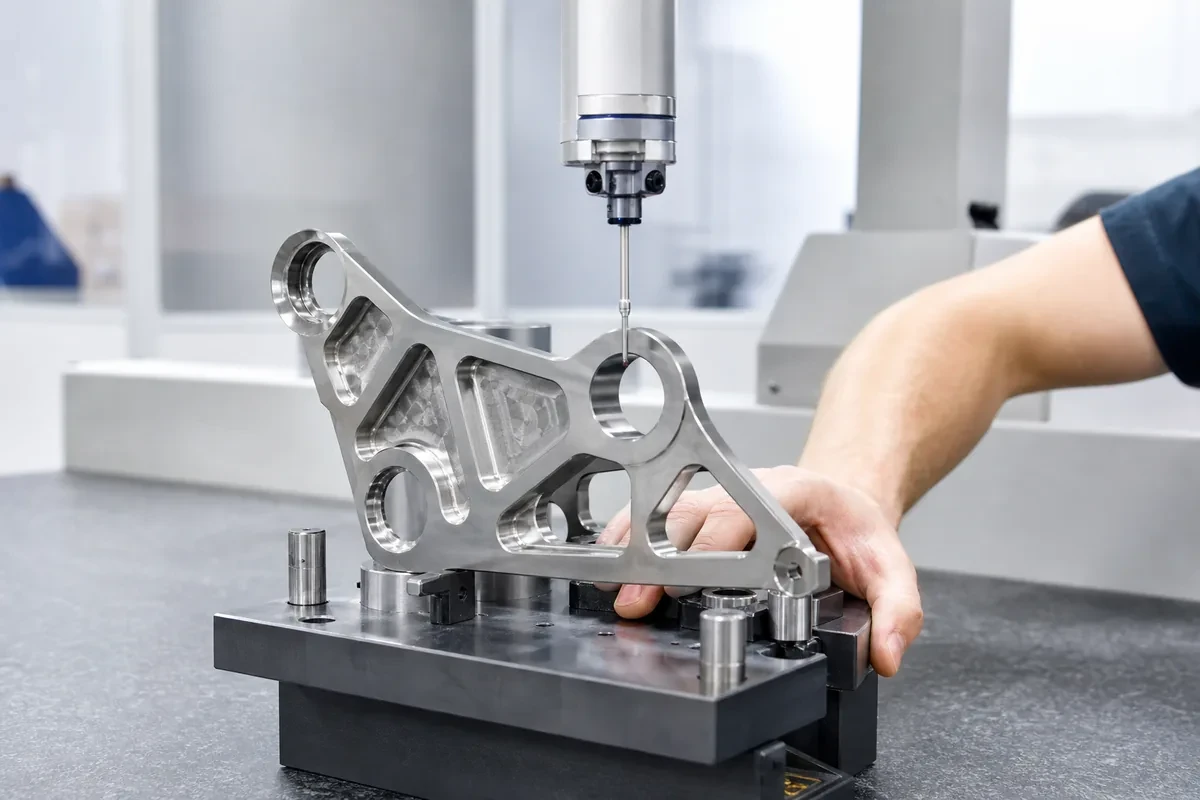
The AS9102 form has three parts: design characteristics, a physical inspection of the first article, and a statement of conformity. A proper FAIR lists every characteristic on the drawing with a measured value, the instrument used, and a balloon number cross-referenced to the drawing.
A "FAIR" that lists ten dimensions on a part with sixty characteristics is not an AS9102 FAIR. Our guide to quality control and FAIR explains what a complete report contains.
Aerospace parts need material traceability to the mill heat, and process records retained for the programme's life — often 10 to 30 years. Ask how records are stored, how a part serial is linked to a heat number, and what happens if a customer needs records from five years ago.
A supplier who says "we can find it" is telling you it is not a system.
Certified suppliers are not automatically more expensive on the same part, but the system costs money and it appears somewhere:
| Cost element | Effect on price |
|---|---|
| Documentation and FAIR | 5–15% on a first article |
| Material traceability | Small, but requires buying certified stock |
| In-process inspection | 5–10% more inspection time |
| Nadcap special processes | 10–25% premium over commercial finishing |
| Record retention | Administrative overhead, not per part |
For a part with a commercial equivalent, expect AS9100 supply to run 15–35% higher than a general machine shop. If a quoted AS9100 price is at parity with a commercial shop, ask how — usually the answer is that inspection or documentation has been reduced.
If the part goes into an aircraft, an engine, or a space system, it is usually contractually required — you do not get to choose. The interesting question is where else it is worth paying for.
It is worth it when:
It is not worth it when the part is a bracket in a machine tool, and the 20% premium buys documentation nobody will read.
Aerospace purchase orders carry flow-down clauses — requirements from the prime contractor that must be passed to every supplier in the chain. They are easy to miss because they live in the PO terms, not on the drawing.
Typical flow-downs include:
A supplier who signs the PO without reading the flow-downs has accepted obligations it may not be able to meet, and the failure surfaces years later when a regulator asks for records. When you send an aerospace RFQ, state which flow-downs apply and ask the supplier to confirm in writing that they can meet them. That single question filters out shops that hold the certificate but not the practice.
The FAIR is not the end of the process; it is the gate. A first article that passes should trigger three things: approval to run the balance of the order, a record of the process settings used, and a decision about whether the process is capable or merely lucky.
The last point is the one buyers skip. A FAIR with every dimension inside tolerance but several sitting near the limit is a process running at the edge. Ask for the actual values, not just pass/fail, and look at the distribution: values clustered mid-tolerance suggest a stable process; values scattered toward one limit suggest a setup that will drift.
On aerospace parts, that distinction is the difference between a supplier you can schedule and one you have to inspect around. It is worth a conversation before the second order, when there is still time to adjust.
No. AS9100 includes all of ISO 9001 plus aerospace-specific requirements. An ISO 9001 certificate does not satisfy an AS9100 flow-down, though an AS9100 certificate covers ISO 9001.
The current revision. Certificates reference the revision, and a supplier certified to the previous revision may be mid-transition. Ask which revision the certificate is against.
A separate accreditation programme for special processes — heat treat, chemical processing, NDT, welding. It is not the same as AS9100 and is not issued by the same bodies. A machined part usually needs both: AS9100 for the shop, Nadcap for the finishing house.
Often not for the prototype itself, but the process discipline is what you are evaluating. Buying a prototype from a certified shop tells you how they will behave in production; buying from an uncertified shop tells you nothing about that.
Typically annually or every three years depending on the certification cycle, with surveillance audits in between. The certificate expiry date tells you where in the cycle they are, and a certificate about to expire is worth a question.
Verify the certificate in OASIS, read the scope, confirm the site, name the Nadcap sources for special processes, and insist on a real AS9102 FAIR with balloon numbers.
Those five checks take an hour and eliminate most of the risk that the certificate was bought rather than earned. The inspection side of the same conversation is in our quality control guide, and the tolerance expectations for aerospace work are covered in the tolerance breakdown.
