


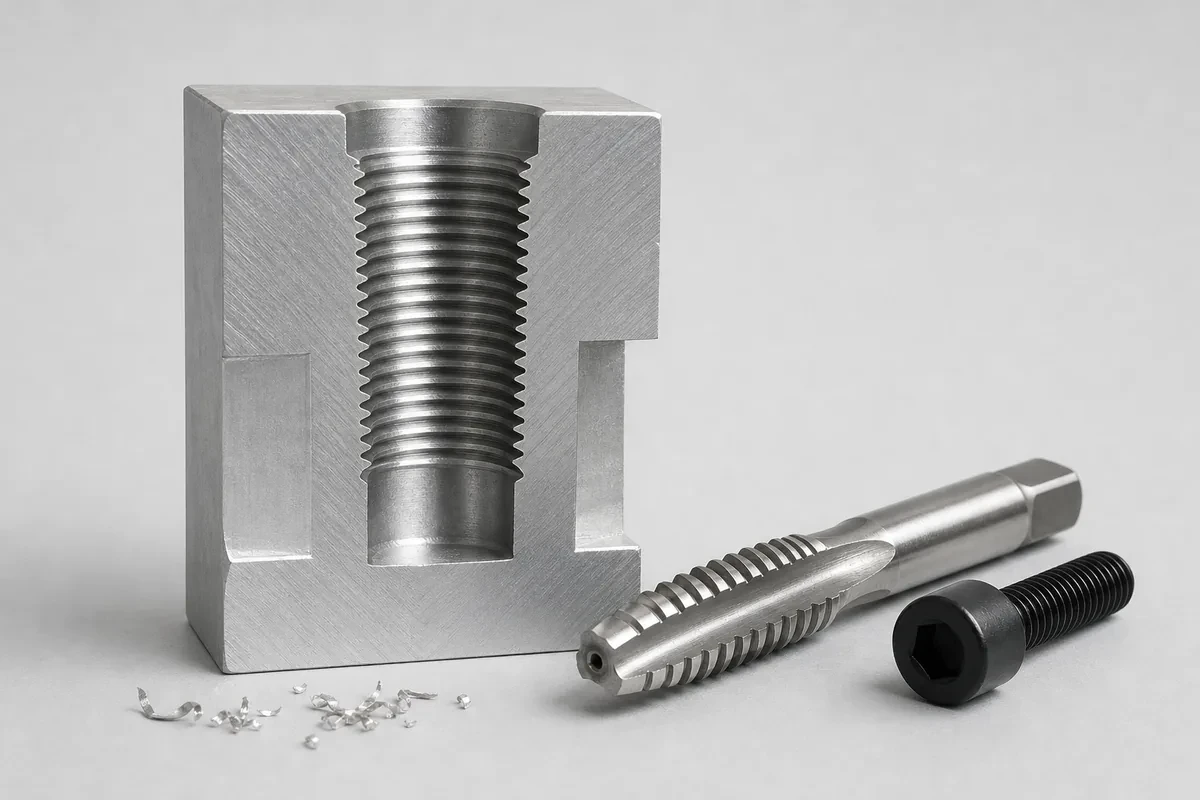
"How deep should I tap this hole?" is one of the most common questions on a machining drawing, and the usual answer — "as deep as possible" — is also one of the worst. Extra thread depth in aluminum adds tapping time, increases tap breakage risk, and delivers almost no additional joint strength, because the load is carried by the first few threads whether you cut six or sixteen.
This guide gives the working depth rules for aluminum, explains why the number stops mattering after a point, and separates the three depths that designers routinely confuse: drilled depth, tapped depth, and usable thread depth.
For a tapped blind hole in aluminum, specify 1.5 x nominal diameter of full thread engagement for a bolted joint, and up to 2 x D where the joint sees repeated assembly or vibration. Beyond that, extra depth buys essentially nothing.
| Material | Recommended full-thread engagement | Notes |
|---|---|---|
| Aluminum 6061 / 6082 | 1.5–2 x D | Soft, low shear strength; more engagement than steel |
| Aluminum 7075 | 1.5 x D | Stronger, but still use a thread insert for frequent service |
| Mild steel | 1.0–1.5 x D | Bolt usually fails before the thread strips |
| Stainless 304 / 316 | 1.5 x D | Galling risk; consider a coarser thread or insert |
| Cast iron | 1.5–2 x D | Brittle, lower thread shear strength |
| Engineering plastics | 2 x D or insert | Creep dominates over stripping |
For an M6 hole in 6061, that means about 9–12 mm of usable thread. An M6 x 25 bolt in a 20 mm deep tapped hole is not stronger than the same bolt in a 12 mm hole.
Thread load is not distributed evenly. Under tensile preload, the first engaged thread carries roughly 30–40% of the load, the second about 25%, the third about 15%, and by the sixth thread the contribution is close to zero. This happens because the bolt stretches and the nut (or tapped hole) compresses, so the two pitch profiles drift out of phase along the engagement length.
Adding threads past the fifth or sixth is therefore adding material that carries no load. It does still add cost: a tap has to cut it, chips have to clear it, and in a blind hole the tap has to be driven further into a space where chip evacuation is worst.
The failure mode also changes. In a properly designed aluminum joint at 1.5 x D, the bolt typically strips the internal thread before the bolt itself yields, which is why aluminum joints are the ones where engagement length genuinely matters. But once the thread is long enough that failure would occur in the bolt instead, making it longer cannot help — the bolt is now the weak link. A useful design target is to size engagement so that bolt failure and thread stripping occur at similar loads, then add a modest margin.
For a broader look at how thread callouts affect manufacturability, see our guide to threads and tapped holes.
Drawings frequently specify a single depth for a blind tapped hole. In practice there are three distinct dimensions, and confusing them is the main reason taps break and bolts bottom out:
| Depth | What it means | Typical allowance |
|---|---|---|
| Usable thread depth | Length of full-form thread the bolt can engage | 1.5–2 x D (design requirement) |
| Tapped depth | How far the tap actually cuts | Usable depth + 2–3 pitches (tap lead-in) |
| Drilled depth | How deep the pilot hole goes | Tapped depth + 2–3 x D (chip space + drill point) |
A bottoming tap has a short lead (1–1.5 pitches) but is fragile; a spiral-point or spiral-flute tap needs 2–3 pitches of runout. The drill point itself adds roughly 0.3 x D of cone that no tap can follow. And chips from a blind hole have nowhere to go except back up the flutes, which is why blind holes need noticeably more clearance than through holes.
Worked example for M8 x 1.25 blind in 6061, targeting 12 mm of usable thread (1.5 x D):
So a note reading "M8 x 1.25, 12 deep" is genuinely ambiguous. "M8 x 1.25, 12 full thread min, drill 23 deep" is not.
Pilot drill size controls how much of the thread profile is actually formed. A smaller drill gives a higher percentage of thread, but torque rises sharply and tap breakage becomes likely — especially in aluminum, which is soft and gummy.
| Thread engagement | Pilot drill (M8 x 1.25) | Tap torque | When to use |
|---|---|---|---|
| 75% (standard) | 6.8 mm | Baseline | General purpose |
| 65% | 6.9–7.0 mm | ~30% lower | Deep blind holes, small taps, gummy alloys |
| 55% | 7.1 mm | ~50% lower | Very deep holes, difficult-to-tap materials |
| >80% | 6.7 mm or less | 2x or more | Rarely justified; high tap breakage |
Common misconception: a 55% thread is 45% weaker. It is not. Thread stripping strength falls only slightly with reduced engagement percentage, because the shear area of the internal thread changes far less than the torque does. Dropping to 65% in a deep blind hole often improves yield more than any other single change. Our DFM rules cover this trade-off alongside other hole-design decisions.
Aluminum threads wear. If a joint will be disassembled more than a handful of times — a service cover, an inspection port, a fixture that gets reconfigured — a helical wire insert or a solid keyed insert is the correct answer, not a deeper thread.
| Situation | Recommendation |
|---|---|
| One-time assembly, low load | Tap directly, 1.5 x D |
| Occasional service (<10 cycles) | Tap directly, 2 x D |
| Frequent disassembly, or vibration | Helical wire insert, 1–1.5 x D |
| High load in thin boss | Solid keyed insert, or through-bolt with nut |
| Blind hole, very deep | Form tap (roll tap) if material allows, or insert |
Inserts also solve the galling problem in stainless and the creep problem in plastics. They add a part and an installation step, but they convert a wear-limited joint into one where the bolt is the replaceable consumable.
Drilled depth was specified as thread depth, so there is no room for the tap lead or the bolt end. The bolt torques up against the bottom of the hole and the joint never reaches preload. Always verify that bolt length minus material thickness is less than usable thread depth.
Chips packed in the bottom, insufficient chip space, or a 75% thread at 3 x D depth. A spiral-flute tap that pulls chips out, a larger pilot drill, or a form tap all address it. Broken tap removal in aluminum is possible but rarely leaves a usable thread.
Usually a combination of too-short engagement and an undersized or worn tap producing a loose thread. Also check that the specified torque is appropriate for aluminum — a value copied from a steel-joint table will strip an M5 thread reliably.
More likely with fine threads and soft material. A coarse pitch and a small lead-in chamfer at the hole mouth (typically 0.5–1 x pitch, at 90°) make a bigger difference than most designers expect.
Coordinate the hole position callout with the mating part. A thread that is deep enough but misaligned is still a scrapped assembly; our tolerances guide explains how positional tolerance interacts with fixed fasteners.
There is no hard maximum, but there is no benefit beyond about 2 x nominal diameter. Load concentrates in the first three to six threads, so deeper threads add tapping time and breakage risk without increasing joint strength.
Drilled depth should be usable thread depth plus 2–3 pitches for the tap lead, plus another 2–3 x diameter for chip space and the drill point. For M8 at 12 mm usable thread, about 23 mm of drilled depth is typical.
It can be for a low-load, single-assembly joint, but 1.5 x D is the safer default because aluminum has lower shear strength than steel. For anything that gets serviced, use 2 x D or an insert.
Much less than people assume. Going from 75% to 65% thread engagement reduces tap torque by roughly a third while reducing stripping strength only slightly. It is one of the best fixes for deep blind holes.
Roll (form) taps work well in ductile aluminum alloys, produce no chips, and generate stronger threads through work hardening. They require a precise pilot drill size and do not suit all alloys, so specify them deliberately rather than leaving it to the shop.
If a tapped hole is critical to your assembly, resolve the three depths and the engagement percentage before the drawing is released. It is a short conversation that prevents broken taps, bottomed-out bolts, and stripped threads on the first article.
